The agreement provides for joint programs for students, planning and design of various tools and equipment. “One of the largest-in-scale scientific projects is the commissioning of nuclear reactor PIK in Gatchina near St. Petersburg. I’m certain that in the nearest 10–15 years this nuclear installation will be the best in Europe and, possibly, in the whole world,” Sebastian Schmidt, a representative of the Juelich Research Center, said.
“The agreement was reconciled for a long time and was formally signed at last. This is an official formal platform for interaction in using neutrons to study matter,” Mikhail Kovalchuk, head of the Kurchatov Institute, said.
According to Kovalchuk, Russian scientists cooperate with their European colleagues on several large-scale projects. He says: “Today in Europe a set of mega-projects are implemented, which cost many billions euro. For instance, in the south of France, the international nuclear reactor is built, which costs over € 10 billion, there are two projects in Germany at several more billions euro, plus the European synchrotron in Grenoble. The Kurchatov Institute on behalf of Russia represents Russia’s interests in these organizations.”
“Russia is the largest investor in these mega-projects after Germany. Russia invests more than € 2.5 billion euro. The essential element of the scientific policy of the Russian State is to use these governmental investments efficiently,” Kovalchuk noted.
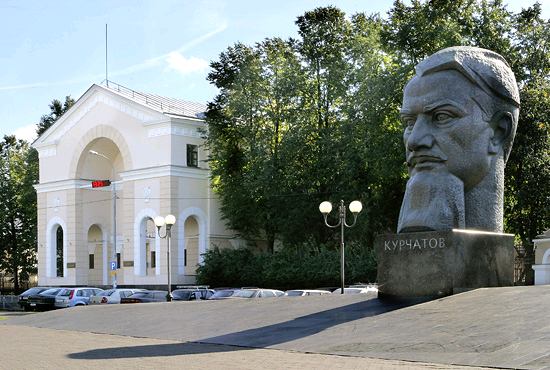
The National Research Center Kurchatov Institute was founded in 1943. The Center’s key activity areas include development of nuclear power, controlled nuclear fusion and plasma processes, low and medium energy nuclear physics, solid state physics and superconductivity, and meson physics. Also, Kurchatov Institute carries out fundamental and applied research in the field of molecular physics, physical and inorganic chemistry, plasma physics and chemistry.