We continue keeping the readers informed about what is going on at the Russian nuclear construction sites, which are entering the home stretch. These include the construction of Unit 1 of Leningrad NPP Phase II, which start-up is set for the next year. A number of unique technologies have been used on the site, which we want to highlight.
In the construction of Leningrad NPP Phase II large lifting cranes are used; preliminary calculations demonstrated efficiency of the use of large-size equipment. The builders are especially proud of a Liebherr crane with a lifting capacity of 1,350 tons and a Manitowoc crane, which can handle 700-ton items.
“This expensive machinery is not available to all contractors. The more expensive a crane, the more expensive one hour of its operation,” Alexander Chebotarev, the Deputy Director for Capital Projects of Leningrad NPP Phase II, says. “The contractors who are operating at the reactor buildings of Units 1 and 2, as well as turbine islands, have estimated that some works can be done faster,” Chebotarev continues. “Unlike Novovoronezh and Rostov units, the dense rebar arrangement at the Leningrad units requires more time. We enlarged the blocks at maximum using the on-site assembling approach and installed those using cranes,” he says.
Innovations in detail
One more innovation at the Leningrad NPP Phase II construction site – couplings – helped solve the problem with joining rebar packs. “It turned out to be easier to assembly an enlarged 12-meter tier weighting 350 tons using couplings on the ground and then lift it by the crane,” Alexander Chebotarev notes.
Builders were breaking head over the formwork design for a long time. What to do to optimize the process? “Our unit is different from the Novovoronezh one in a seismic gap of 20 cm in each building. It caused problems with the formwork,” the Deputy Director for Capital Projects of Leningrad NPP Phase II says. The large formwork was not possible to install with such small gap; therefore, they decided to use small-panel forms, but it didn’t accelerate the process either. Then, they used the metal sacrificial formwork. This helped shorten substantially the time for reinforcing and concreting of the reactor building jointwork. Another solution was employed for self-moving formwork; the inner and outer containments were concreted simultaneously.
To prepare the stuffing
This year’s target is to enter the stage of welding of the main circulation piping (MCP), while combining construction and installation operations at maximum, according to the Leningrad NPP Phase II Director. The solution was off-standard one. The builders decided to “stuff” the containment building while the “hat”, the dome, is not on. A polar crane was assembled. First, the table brackets were fastened on the containment to make an even surface to lay the crane rails. The polar crane parts were enlarged in on-site assembling at maximum. Then, they installed the electric equipment and weights. This hadn’t been done previously. The polar crane electric systems were installed also before the dome installation. Temporary floors were built to protect the electric equipment from moisture.
Besides, the specialists used a new type of formwork, i.e. formwork on trusses. “This arrangement allowed allocating rooms for welding of MCP,” Alexander Chebotarev says. Normally, the 26-th elevation is concreted (it matures 100% in 28 days). Then, the formwork is disassembled under this elevation. “There is very little free space there; only after the formwork has been taken away, they start finishing the room. It takes months!” Alexander Chebotarev shares the details with us. Now, the formwork is removed earlier; finishing has been 90% completed in the lower section and free space for the installation of MCP has been prepared. This saves several months before the welding operations begin.
Leaping ahead, we can say that welding of MCP will be made using the well-proven technique, manual. In parallel, the builders plan to weld four butt welds instead of three as before. The principal contractor has purchased a required number of welding machines and trained welders. Only certified personnel will be doing the job.
The open-top approach
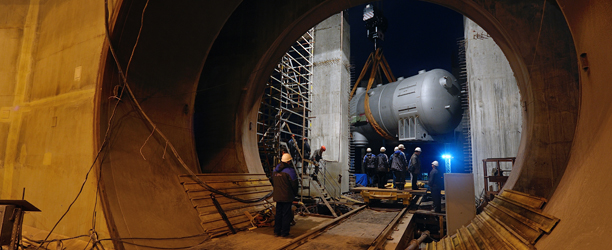
At Leningrad NPP II’s Unit 1 the reactor pressure vessel was installed using so-called open-top approach where the reactor vessel was put inside the containment vertically between trusses of the polar crane rather than horizontally through the transport airlock of the reactor building.
“It was a delicate operation, since the distance from the reactor vessel to the crane trusses was 70 cm,” the Deputy Director for Capital Projects of Leningrad NPP Phase II says. And the huge thing weighting 327 tons had to be put in between them. The operation was carried out using a high-precision crane fitted with instruments, which determined weight of the load and even weather changes,” he says.
Previously, this operation was done in five strokes, now it takes three strokes. The same approach was used to install the pressurizer and the elbow of reactor coolant pump. The installation workers gained 100 days at the reactor building construction.
The next move is to install steam generators using the open-top approach again.
Large sections only
The on-site enlarged assembling of the containment dome has become know-how of the builders at Sosnovy Bor. It was assembled as two tiers rather than three. It was enlarged at maximum during on-site assembling, on the round, and fitted with all equipment. Also, the passive cooling system of the containment was installed in the lower tier. “Previously, it was done when the dome was in place and the work was considered labor-intensive,” the Deputy Director for Capital Projects of Leningrad NPP Phase II emphasizes. Now, it is done in a different way. Four loops of the spray fire-extinguishing system were installed in the upper section of the dome. This is a network of pipes where water is supplied to under pressure. “Having installed the dome, we supplied power to lamps and avoided temporary lighting, so saved the money,” Alexander Chebotarev says.
Churned out reactors
Today, 4,200 people work on the site. In the end of the year 5,000 up 6,000 people will be needed. The first criticality of Leningrad NPP Phase II’s Unit 1 is set for 2015 and it will be commissioned for the commercial operation in a year after. Other reactors of this plant will be started up in 2017, 2019 and 2021. The tight schedule forces the builders to implement the boldest ideas. “The detailed schedule provides for a number of solutions. Some of them are systemic in nature and so we will employ them in building the next reactor units,” the Leningrad Phase II Director concludes.