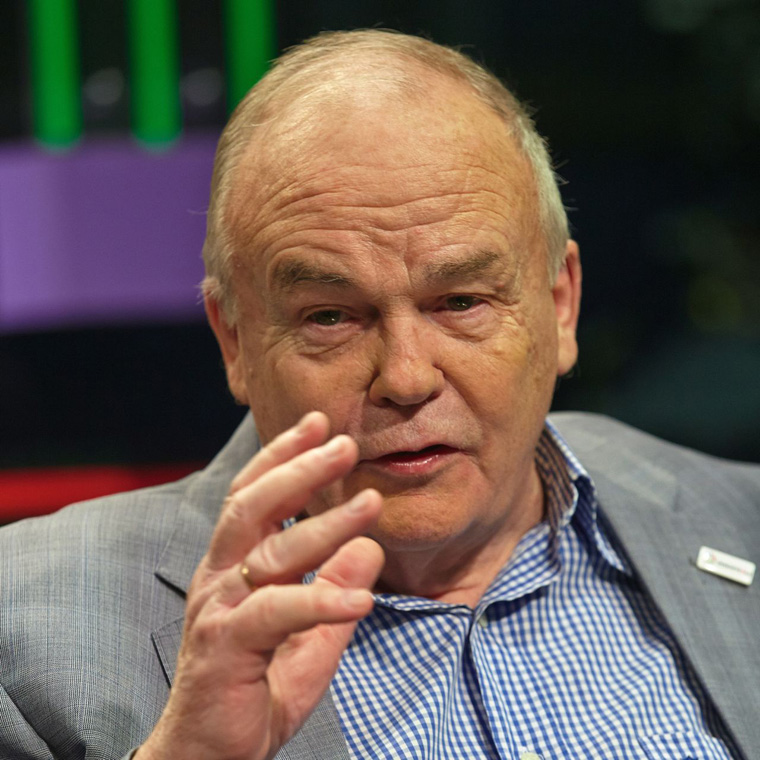
This ambitious idea was voiced by President of the National Research Center Kurchatov Institute, Academician of the Russian Academy of Sciences Yevgeny Velikhov. It should be noted that this scientist is the true leading figure of the fusion energy: he is one of the initiators of the ITER project. In 1972 he founded the chair of fusion energy in the Moscow Institute of Physics and Technology and then the faculty of physics and power engineering based in a branch of the Kurchatov Institute of Atomic Energy (FIAE). He heads the chair today.
Since 1975 Velikhov has headed the soviet program of development of controlled fusion reactors. In 2009 he was elected the head of the board for the ITER development.
At the conference the scientist was speaking about a new “thermonuclear” undertaking. At the forum Yevgeny Velikhov made the opening paper on the project of development of the demonstration hybrid installation consisting of a molten salt nuclear reactor plus the fusion reactor. Velikhov believes that Russia is able to implement such project on its own. Fusion power is capable of solving a number of problems nuclear power is facing. It is not only stable, potent and environmentally clean source of electricity; such systems can dispose of minor actinides and will strengthen safety in the nuclear industry.
Under one of the sector’s development scenarios, by 2100 nuclear capacity in the world will approach 10,000 GW and hybrid systems could be accounted for about 5% of this amount. “We believe that the demonstration machine of the hybrid system can be presented by 2030, if the work goes very fast,” the scientist emphasized.
On his part, Vyacheslav Pershukov, the head of innovations management at ROSATOM, said: “We place orders with institutes to research into certain processes, which take place in the molten salt reactor. In addition to the Kurchatov Institute, this work is carried out by the Research Institute of Atomic Reactors and in part the Institute of Physics and Power Engineering.”
Head of the Russian Domestic Agency ITER Anatoly Krasilnikov believes that the project of the hybrid system can become the ambitious scientific problem, which would allow Russia advancing very far in technologies and innovations. “Russia is just about the only country in the world, which can develop such installation on its own,” he emphasized.