The world has entered a digital era where IT solutions and neural networks are at the heart of every high-tech industry. Armenia sees digital transformation as a primary driver of sustainable growth. Having emerged as a leading developer of innovative digital solutions, the Russian nuclear corporation Rosatom now offers its products to international partners.
Speaking at the Eurasian Economic Forum this June, Armenian Prime Minister Nikol Pashinyan emphasized the critical role of digital transformation for the country. “We are convinced that digitalization opens up new opportunities in our economy, in public administration, and in the social sphere,” Pashinyan said. According to him, Armenia is open to creating cross-border platforms and launching pilot initiatives that will enable the parties involved to both adopt existing technologies and develop their own effective solutions.

Earlier this summer, Rosatom showcased its product lifecycle management (PLM) and computer-aided engineering (CAE) solutions at the Russian Digital Industry conference.
“We focus primarily on digital ecosystems rather than on individual programs,” Rosatom chief Alexey Likhachev explained. By uniting leading industry experts, we have created a full range of import-substituting solutions for nuclear applications, including PLM systems, CAE tools, and BIM (building information modeling—Ed.) technologies. We do not stop at what we have achieved—we adapt our solutions for other industries and offer proven ones to international partners.”
AI, automation, and smart cities
Rosatom’s portfolio includes digital products, solutions, and services for government, business, and industry across seven priority areas: Mathematical Modeling and R&D; Enterprise and Production Management; Digital Infrastructure; Large Construction Project Management; Information Safety and Security; Digitalization of Municipal Services and Processes; and System Integration and Software Development.
Rosatom’s international partners show particular interest in the SARUS product lifecycle management system. Another system is Atom.RITA, a smart assistant for robotic technology. Successfully used by Rosatom Group companies, this platform is designed for developing and managing robotic process automation (RPA) tools.
In-demand AI-powered solutions include Atom.Poisk, a tool for searching information across documents in the corporate information systems, and Atom.Oko, an OCR solution for recognizing, analyzing and processing documents of various formats.
“Mathematical Modeling and R&D is another digital product that could be of interest to foreign customers. These digital solutions allow for complex calculations and simulations necessary for designing and managing large-scale engineering projects. This could prove especially valuable for developing countries with ambitious construction and energy plans,” said Victoria Degtyareva, associate professor at the State University of Management’s Department of Innovation Management.
Rosatom’s customers for IT solutions include major industrial, energy, and oil-and-gas companies, leaders of the strategic sectors of the Russian economy.
Another product, quite different from others, is Rosatom’s Smart City, a digital municipal management platform that streamlines interaction between residents, municipal authorities, contractors, utility companies, regional agencies, and other stakeholders. The platform is being successfully deployed in Russian regions.

Digitalization penetrates every key aspect of Rosatom’s business. The so-called digital twins—virtual copies of devices or processes—are used across many different operations, from developing and engineering nuclear power plants to creating new materials, including new types of nuclear fuel and composites. Digital twins help increase efficiency, save time during product development, reduce the number of physical tests, and ultimately lower the cost of the final product.
Nuclear-powered data centers
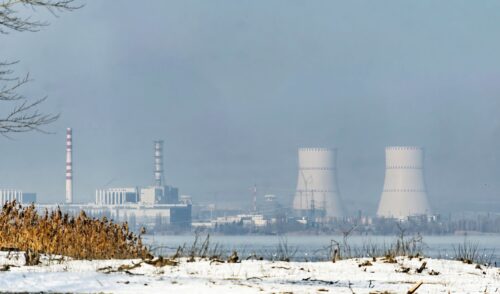
Rosatom is one of the leading players in the Russian data center (DC) market, ranking among the top five DC operators in the country. Almost ten years ago, the Russian nuclear corporation pioneered a concept that is now becoming a global trend, combining nuclear power plants with data centers. Since 2018, a data center has been operating near the Kalinin Nuclear Power Plant, which supplies the DC with stable electricity at a fixed rate, giving the facility a competitive advantage.
Rosatom’s DC competence center is AtomData. Currently, AtomData operates five high-tech data centers in Moscow, Saint Petersburg, Tatarstan, and the Tver Region, with a total capacity exceeding 93 MW and more than 6,500 rack spaces. In the near future, the company plans to deploy modular data centers at three other nuclear power plants in Russia. Rosatom consistently develops infrastructure, leveraging the unique opportunities provided by the integration with nuclear generation.
Rosatom’s comprehensive offering includes electricity supply for data centers (locating data centers at nuclear plant sites or building small modular reactors near existing data centers); construction of data centers; colocation services (placing customer servers and network equipment in a data center), cloud services (renting computing power), and custom-built data centers.
Thus, Rosatom remains at the forefront of technology trends by steadily developing key digital capabilities, successfully deploying its products domestically, and offering the best solutions to both Russian and international markets.
Photo by: EEF, Rosatom State Corporation, Rosatom Infrastructure Solutions