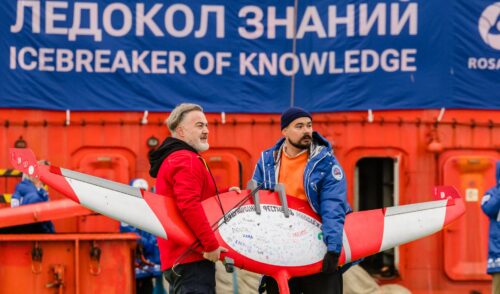
Participating in the Icebreaker of Knowledge 2025, an international Arctic expedition organized by Rosatom, proved to be an unforgettable experience for student Priya Wicaksono and Professor Topan Setiadipura from Indonesia. They shared how they joined the expedition, the details of the voyage, and their most vivid impressions from it.
Priya Wicaksono says he learned about the Icebreaker of Knowledge 2025 expedition by chance while searching the Internet with his father for educational programs for students. “I decided to apply because it sounds like a dream come true,” Priya says. The selection process was not overly difficult for him. “I first started by taking quizzes on various topics and finally recorded a video presentation about the role of nuclear energy in Indonesia. Overall, the selection process challenges my understanding and knowledge, because the topics covered are wide ranging from various fields of natural sciences, and of course on nuclear energy,” Priya explained.
Professor Topan Setiadipura is the Head of the Research Center for Nuclear Reactor Technology at the National Research and Innovation Agency (BRIN) of Indonesia. “So indirectly, I am involved in the nuclear sector in Indonesia by providing consultative services to the Ministry of Energy and Mineral Resources (MEMR), the regulator (BAPETEN), and also state-owned enterprises. As for the Icebreaker of Knowledge 2025, I was invited by Rosatom, most likely due to my previous involvement in many nuclear-related activities in Indonesia with them,” the professor notes.
Knowledge and friendship
The international Arctic expedition launched in mid-August from the Russian city of Murmansk located on the shores of the Barents Sea. From there, the nuclear-powered icebreaker 50 Let Pobedy set a course for the North Pole. On board were 66 high school students from 21 countries, accompanied by experts, including renowned researchers and science communicators from various fields. “My primary responsibility on the expedition was to share my knowledge of nuclear reactor technology and its potential and risks with the students,” Topan Setiadipura explains.
A robust educational program was prepared for the students on the icebreaker, featuring daily lectures and master classes. The members of the expedition also learned about the design and operation of the vessel and conducted a series of scientific experiments that are only possible in northern latitudes. “The most inspiring workshop was on assembling rovers. We worked in teams, where one group was assembling the rovers while the other was programming them. It taught me quite a bit about practical assembly, and for my first time, it went really well,” Priya Wicaksono said. The workshop involved simplified models of advanced mobile rover platforms designed for geological exploration on objects within the Solar System. The models assembled by the students were subsequently tested in North Pole conditions.

According to Priya, socializing with other children was also a crucial part of the journey: “The most fantastic experience I had on the ship was when I met many different people and made many new friends”.
Professor Setiadipura agrees that the social environment was invaluable. “The children have immense talent and potential. This applies not only to their ability to learn science and technology but also to their gifts in other fields, like the arts. Furthermore, being gathered in an isolated situation for several days was a great lesson for them. The way this experience opened their minds to diversity and taught them to respect each other’s cultures and mindsets… I think it’s a great asset for their future growth,” the professor observes.
At the top of the world
The expedition culminated with the icebreaker’s arrival at the North Pole, the point where the Earth’s imaginary axis intersects the surface in the Northern Hemisphere. The expedition members say it is a day they will remember for the rest of their lives.
“It was really emotional, especially since I reached the North Pole on the 80th Indonesian Independence Day, August 17th. Seeing the Arctic horizon was amazing, and knowing we were on top of the Earth added to that feeling. But the most memorable moment was the opportunity to swim in the Arctic water, which was about 4 km deep and around minus 1 degree Celsius. Somehow, in that freezing water, from the moment I prepared to jump, to being in the water, and after getting out, I felt comfortable… no cold at all. I think it came from the joy and the feeling of having that once-in-a-lifetime moment,” Topan Setiadipura shared his impressions.
Many of the international participants were the first from their respective nations to have conquered the top of the planet.
Inspiration for the future
The expedition provided more than just unforgettable emotions; it became a venue for knowledge exchange, a source of inspiration, and a symbol of international cooperation. For many, it helped dispel misconceptions regarding atomic energy.

“Before the trip, I had some reservations regarding nuclear energy, especially about the dangers of radiation that affect both people and the environment. This was mainly because my knowledge of the nuclear industry was limited at the time. It was only through the process of registering for this expedition and the expedition itself that I became much more informed about the nuclear industry. I learned that nuclear facilities are not haphazardly constructed but are carefully planned to account for the most extreme emergencies, and that safety is always paramount in the industry,” said Priya Wicaksono. Following the expedition, Priya reflected on the benefits nuclear energy could bring to his country and the planet. “The future of nuclear energy, if harnessed for the benefit of humanity, could spark a revolution in the energy sector itself,” he believes. The student added that the expedition helped him define his career path: “I’ve decided to pursue natural sciences, possibly as a physicist, I’m grateful that the expedition helped me make up my mind.”
Topan Setiadipura admits that while he was already a proponent of nuclear power, the expedition expanded his understanding of the peaceful applications of radiation technologies. “In fact, this experience strengthened my conviction that human civilization needs nuclear energy. By using it, we can accomplish things that would be impossible otherwise, such as reaching the North Pole in a matter of days. This capability can be extended to other areas necessary for developing a sustainable civilization. Moreover, as we experienced on the icebreaker, we can live safely in close proximity to a nuclear reactor with current technology,” Topan Setiadipura concluded.
Photo by: “Knowledge Icebreaker” project