Rosatom showcased its achievements in the development of TVS-K fuel at the International Nuclear Energy Industry Innovation Expo held in China. Read our overview of the nuclear fuels for conventional and innovative reactors being developed and manufactured by the Russian nuclear corporation.
The 4th International Nuclear Energy Industry Innovation Expo took place in China’s Shenzhen in mid-November. The event brought together the academic community and over 100 major organizations from the nuclear industry. The centerpiece of Rosatom’s exhibition booth was an interactive column displaying the Russian-designed TVS-K nuclear fuel intended for Western-designed pressurized water reactors (PWRs). Another section of the exhibition was dedicated to 75 years of Russian-Chinese cooperation in nuclear energy, nuclear medicine, and logistics. The corporation’s booth was visited by a delegation of exhibition organizers led by Shi Yubo, Chairman of the Board at the China Energy Research Society.
It was no coincidence that the fuel assembly model was chosen as the key exhibit. Rosatom is a global leader in uranium enrichment and nuclear fuel production. TVEL Fuel Company is Rosatom’s subsidiary responsible for these activities, including enrichment of uranium products, fabrication of fuel assemblies and their components, and provision of services related to the development, engineering, licensing, and operational support for nuclear fuel.
For PWRs and beyond
TVEL produces nuclear fuel for every type of Russian-designed power reactors, including VVER-440, VVER-1000, Gen III+ VVER-1200, RBMK, EGP-6, as well as the BN-600 and BN-800 fast neutron reactors, meeting all the needs of nuclear power plants in Russia and supplying reactors with fuel in a number of other countries. Rosatom’s fuel company holds a 17% share of the global nuclear fuel market.

Notably, TVEL manufactures fuel for VVER-1200, the flagship reactor of the Russian nuclear power industry. This fuel features fuel rods with increased uranium content, enabling reactors to operate in flexible, variable-duration refueling intervals and load-following mode and improving the reactor economy.
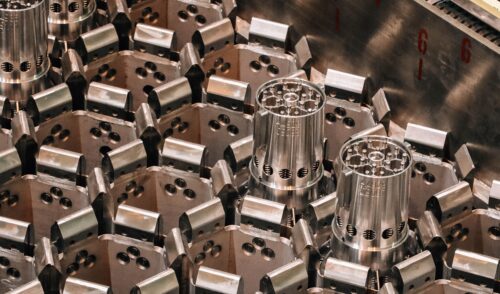
TVS-K is a line of fuel assemblies with a square cross-section designed for PWR reactors, with the capability to adapt to other fuel assembly dimensions. The design employs two families of Russian zirconium alloys, E110 for the spacer grids and fuel rod cladding, and E635 for the guide thimbles. The combination of these materials ensures prolonged reactor operation regardless of the chemical properties of coolant water, offering high reliability and corrosion resistance with minimal formation of oxide films.
The TVS-K design integrates the best solutions successfully proven in VVER reactor fuel assemblies. TVS-K is a proprietary design, free from third-party intellectual property rights.
Fuel innovations
TVEL is also developing innovative types of nuclear fuel, such as accident-tolerant fuel (ATF) for example. Belonging to a new generation of safety, this fuel is resistant to overheating should the supply of cooling water to the reactor core cease. This is primarily achieved through eliminating the steam-zirconium reaction that occurs when the temperature of zirconium cladding rises, leading to its degradation. TVEL is developing accident-tolerant fuel for both VVER reactors and Western-designed reactors.
Last year, the reactor of Rostov Unit 2 was loaded with ATF rods for the third consecutive time. That means the fuel assemblies containing the experimental fuel rods will complete the third 18-month operation cycle, which is a standard nuclear fuel cycle for Russian VVER-1000 reactors.
Another innovation developed by TVEL is REMIX fuel for VVER reactors. It is produced from a non-separated mixture of regenerated uranium and plutonium obtained from reprocessing spent nuclear fuel (SNF), with a small amount of enriched uranium added to it later. This allows for reusing the plutonium contained in the irradiated fuel and also the unburned uranium-235. REMIX fuel will reduce the consumption of natural uranium in the fuel cycle. Late last year, REMIX fuel assemblies started their third 18-month pilot operation cycle at Unit 1 of the Balakovo NPP.

Mixed oxide (MOX) fuel is another type of nuclear fuel produced from SNF, but it is based on plutonium oxide generated in power reactors and depleted uranium oxide. With these innovations, the nuclear power industry is heading towards closing the nuclear fuel cycle, reducing nuclear waste, and having a new source of feedstock for the fabrication of fresh fuel through the multiple recycling of spent nuclear fuel.
MOX fuel is already mass-produced and is intended primarily for fast neutron reactors. It has been three years now since the BN-800 fast reactor at Beloyarsk Unit 4 was fully converted to MOX fuel. However, this fuel can potentially be used in new-generation pressurized water reactors as well. In March of this year, Rosatom began researching the neutronic performance of a VVER-S reactor utilizing MOX fuel.
Additionally, TVEL manufactures nuclear fuel for all research reactors in Russia and some other countries. TVEL also supplies nuclear fuel for the Russian icebreaker fleet and the world’s first floating nuclear power plant, Akademik Lomonosov.
Playing the long game
Rosatom researchers are also working on the development of nuclear fuel for fundamentally new reactor types. One such design is the high-temperature gas-cooled reactor (HTGR). HTGRs will be key facilities at nuclear power stations designed to provide high-grade heat to industrial sites, particularly those producing ammonia or hydrogen via steam methane reforming process. Recently, a pilot production line for HTGR fuel was established at one of Rosatom’s facilities. This fuel consists of coated fuel particles and fuel compacts capable of operating under extremely high temperatures.
Photo by: TVEL JSC, FSUE Mining and Chemical Combine, Balakovo NPP