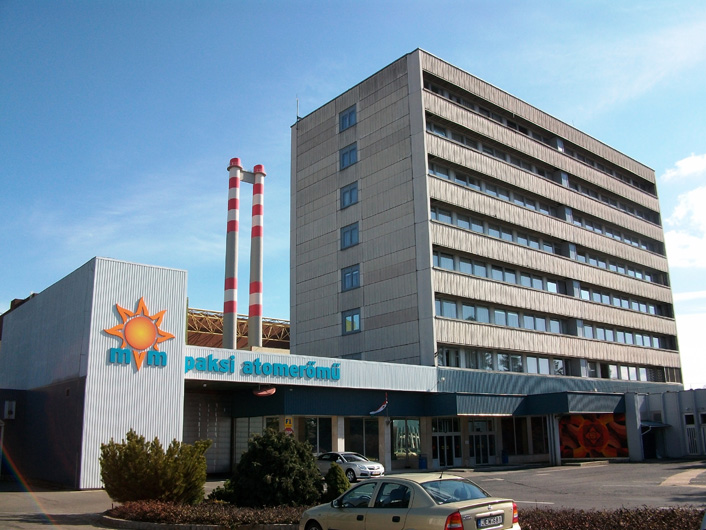
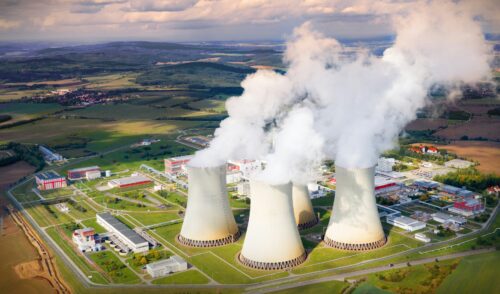
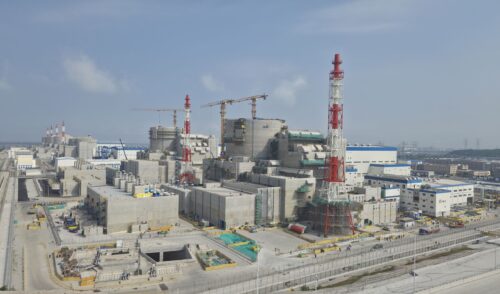
Advisor to the Paks Plant Manager P?l Kov?cs opened the door to the stairway and a group of foreign journalists went up to the observation gallery of the main control room. There are four operators behind the glass. They sit at control boards with computer displays, dozens of switches, keys, buttons and blinking indicators. They control Unit 4 of the plant. The board on the wall showed 488 and 489 megawatts in turn. That was the power capacity of the Russian-design 500-megawatt VVER-440 reactor at that moment, which Kov?cs just proudly showed to his guests from the similar gallery in a large reactor hall on the other side of the complex. Then he turned to the window and showed the guests a wide flat grassy lawn. “This is the site for new reactors,” he said.
Economic ties
In January this year Russia and Hungary signed an intergovernmental agreement concerning the cooperation in construction by ROSATOM of two new 1000-megawatt reactors at Paks NPP and in March an agreement concerning provision of a loan of up to EUR 10 billion for 35 years from Russia, which would make up 80% of the project funding, was signed. This agreement will tie up Hungary and Russia for decades, increase the energy potential of this Central European country, and create thousands of jobs there.
The agreement was signed just before the parliamentary elections in the country, which confirmed the constitutional majority of the ruling party Fidesz led by Prime Minister Viktor Orb?n. The Hungarian socialists put criticism on Orb?n for insufficient consultations with the opposition concerning this agreement. However, the parliament of Hungary ratified both the intergovernmental agreement and the loan agreement.
There in Paks, which is about 100 kilometers from Budapest, the new reactor are spoken about as a crying need and the nuclear power plant built in the 1980s of the past century under the COMECON cooperation is considered the national pride of Hungary. According to the plant’s Technical Director G?za Pek?rik, if previously Paks NPP produced about 40% of Hungary’s electricity, now, because of the drop of production at other power plants, its share has grown up to 50.7%.
For 20 years more
The plant construction started in 1975. Its pillar stone now is on the display in the special atomic energy museum located near the main entrance where groups of Hungarians come every day for excursions. The first reactor was commissioned in 1982 and the last one, the fourth reactor was started up in 1987. Their initial design service life was 30 years, Pek?rik says. In recent years the large-scope and costly work has been carried out to study the historic data on loads on various units, inspect and partially replace parts aiming at the plant certification for the next 20 years. According to the Technical Director, the first reactor has been already certified and the second one is undergoing the certification process.
Therefore, the new reactors will not double Paks power capacity but gradually replace the currently operating four reactors, which power capacity is 2,000 MW, with two new reactors of the same total power capacity, Kov?cs explains, pointing to the strictly protected cubes of the structures painted in green and brown. The overlap will be 5 to 7 years until the point of time when the currently operating reactors will be decommissioned, he said. The construction work will start in 2016 or 2017, he says.
Russia and Hungary are to conclude three more agreements before the construction of the new reactors can start at Pask NPP. They will deal with planning, construction and commissioning of the new reactors, nuclear fuel supply and disposal and reactors operation and servicing.
A factor of energy security
In Hungary the rivers are lowland ones, including the great Danube running close to Paks, which in its mid-stream slows down because of the dropping height differential. Thus, the hydropower development would have led to flooding of large territories to build water reservoirs, which is unacceptable today from neither environmental protection nor political considerations.
“We don’t have hydro energy resources; there is not much of the wind potential, since wind power can bridge a smaller gap than expected. Given the current energy needs, the renewable can account for not more than 30%. Therefore, the only possibilities we have are nuclear and import. The import is dependence, at a certain point of time it becomes a national security issue. Therefore, one has to be wise in trading between these sources,” Kov?cs says.
As Paks develops, Hungary will be able to supply power not only for its own needs but also to the EU market, which, Kov?cs says, will include neighboring Serbia by the time the new reactors are up and running. Hungary also relies on electricity supplies to Italy. “If Europe had had the same strong winter as in the USA this year, we estimate that it would have coped with it with great difficulties. We want to feel ourselves secure, so nuclear should be part of the energy mix not only of Hungary but Europe as a whole,” Kovacs says.
After Fukushima
The fact that the plant is situated in the center of Europe entails special safety requirements, the plant top managers say. According to Technical Director Pekarik, improvement of safety systems started in 1992-1994 by introduction of the system AGNES, which implied technological upgrading and modernization of buildings.
After the accident at Fukushima that raised a new wave of concerns over safety of nuclear power, additional stress tests were carried out. “The plant is already protected against seismic hazards. Even highest floods at the Danube don’t affect it,” Pekarik says. According to the Technical Director, dams on the banks of the Danube are made so that on the left bank they are somewhat lower that on the right bank where Paks is situated. Therefore, in case of an unprecedented flood and overflow water can flood the territory on the left bank but won’t affect the plant.