The most important part of the IAEA mission is fighting against proliferation of nuclear weapons. Rosatom scientists are ready to help the international agency to fulfill it. Today Russian specialists create a new unique instrument, which will help the experts of the organization to spot illegal weapon production all over the world. It is about producing a master sample of an extremely rare plutonium-244 isotope. It will serve as an ideal isotopic tag, allowing calculating initial composition of an agent, collected by specialists. The agreement concerning production of this tag was achieved on one of the latest IAEA meetings.
Plutonium for the IAEA
The production of new plutonium sample, which will allow with the help of mass spectrometry method spotting possible unstated nuclear developments on the objects upon the IAEA guarantee in the different parts of the world, is done by All-Russian Scientific Research Institute of Experimental Physics (VNIIEF) and analytical radiochemistry and mass spectrometry lab of V.G. Khlopin Radium Institute (Rosatom’s enterprise).
The immediate production of the tag will be done by Federal Nuclear Center in Sarov. The IAEA will send the source material to VNIIEF, for further repreparation. The Radium Institute will certify the samples, after which they’ll go to analytical labs network of the IAEA, where all samples from atomic sites inspections are taken.
In Rosatom they say that the organization is highly interested in this material, since it is more apt for analysis, from technological point of view. There’s no plutonium-244 in atomic reactor run products which makes it ideal reference material for mass-spectrometry analysis.
“This is the most sensitive method of substance detection. It can spot extreme low concentrations – as little as 106 particles/sm3 , – says the NRNU MIPhI Professor Sergey Kireev. The idea of mass spectrometry method is the following: laser emission affects the sample substance, as a result its pass to gas phase takes place, the gas being ionized. The correlation of mass of particles and their charge is calculated, determining isotope composition to a high precision. Thus the IEAE experts will be able to say if the enterprise’s activity is the same as declared.
Personnel and Knowledge
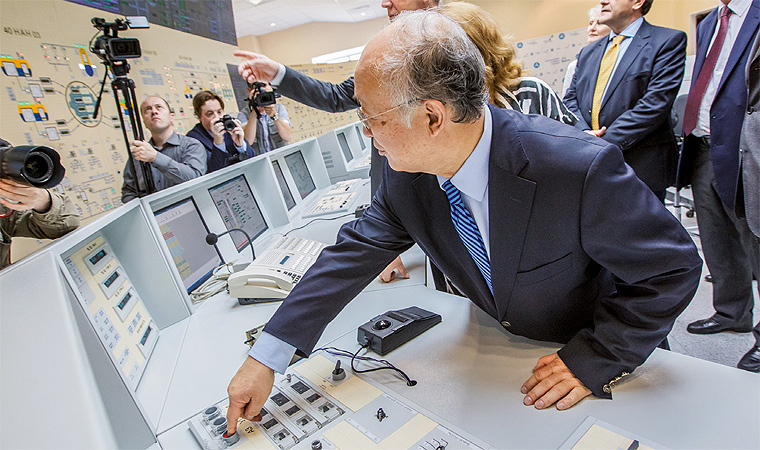
Another line of cooperation between Rosatom and IAEA is in the sphere of personnel training for the Agency. As early as two years ago during his visit to Moscow Yukiya Amano, the IAEA General Director, signed an agreement with the heads of the State Corporation concerning personnel training.
According to the document Rosatom trains and sends minor personnel to work for the IEAE. Accepted, they become staff members with international civil servants’ status and report to the head of the agency. Upon the employment by the IAEA Russia covers the following expenses: salary, bonuses, health insurance, trip to the point of destination. The standard work term is 12 months.
Also a Practical Agreement concerning cooperation in nuclear knowledge management was signed some time ago between IAEA and Rosatom. This agreement is the cooperation roadmap and suggests joint initiative in 7 directions. Among them are: cooperation in organizing international conferences, fulfilling projects of information archivation and keeping critically important knowledge and projects on development of special knowledge packages for various reactor types. Several projects are already planned and being implemented.
A matter of technique
Rosatom supports the wide-scale International Project on Innovative Nuclear Reactors and Fuel Cycles (INPRO), realized under the supervision of the IAEA. The project was offered by Vladimir Putin in 2000. He invited the world community to a wide international partnership in joint development of innovative technologies for nuclear reactors and fuel cycles. INPRO offers its member-states to estimate nuclear energy systems with the use of the INPRO methodology for support of long-term strategic planning and decisions concerning nuclear energy implementation. The methodology implementation experience is being constantly improved. Today 30 states and one international organization (European commission) are the INPRO members.
Acknowledging the IMPRO importance, the IAEA constantly raises the sum of money spared for the project. Rosatom helps the International Agency in this mission. Since 2008 Russia spares annually RUB 23 million for the IMPRO plan realization.
A separate point of cooperation is nuclear medicine. It was more than once that Yukiya Amano thanked Russia for its efforts in fighting cancer. The head of the IAEA also noted the advanced technology used by Russia for cancer treatment. “I must say that Russia and IAEA cooperate in this field and that your country’s government shows concern in this issue. In this sense I’m an optimist – I believe our partnership will develop further”, – said Amano. One of the directions of cooperation with the international organization in the sphere is adaptation of international standards of nuclear medicine. Besides, the IAEA is really interested in developments that Russia could offer, design and production of diagnostic radiopharmaceuticals, for instance, as well as new technologies in therapy, such as neutron and neutron capture therapy, where Russia is an undisputed leader. The cooperation between Russia and IAEA, as experts believe, in future can be based on promoting technologies to developing economies’ markets.