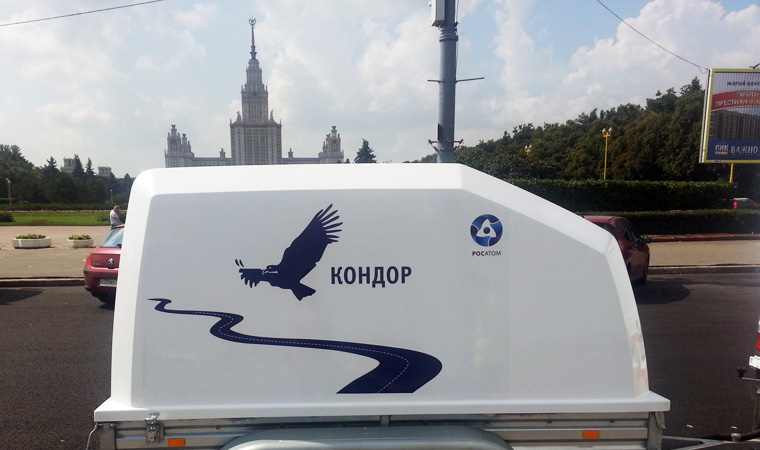
A development model was successfully tested on the Moscow-Saint-Petersburg Highway, currently under construction. In 2011 Vyacheslav Pershukov, Rosatom’s Director for Innovations, was visiting American national labs, getting familiar with their developments in the nuclear technologies’ sphere. On one of the roads of Texas his attention was caught by a vehicle marked with the familiar radiation hazard symbol.
“Discussing the thing with Leonid Bolshov, an atomist, I started inquiring if there were methods of radiation control and diagnostics of asphalt covering, – he recalls. – And at once we understood that no one had ever answered such a simple question. Thus we came to the idea of trying reconstructing the roadway structure with the help of x-ray emission. Why x-ray? The answer is simple: this method of diagnostic is very well-known and available for industrial use”.
Technical characteristics
This kind of equipment was designed at NIITFA only within a year and a half. NIITFA is Rosatom’s scientific enterprise, developing equipment based on physics of interaction between emissions and matter. The Condor multi-channeled device solves a whole bunch of problems: determines density and degree of density of the roadway upper layer, the thickness of all its layers, wetting zone and the zone of ground softening, blowholes, washboards and foreign bodies.
The device’s operation principle is based on backscatter effect of X-ray tube emission, directed vertically downwards. Condor allows getting exact information concerning physical parameters of the roadway’s upper layer. In order to determine distribution of the road-cover’s layers and thickness, including, besides the cover itself, the layers of small rock and sand, the device uses georadar – a source of electromagnetic waves, raying the surface.
It is this electromagnetic raying that gives real opportunities to prevent risks like roadway collapse. Thanks to Condor the constructors today can surely know is there are any washboards or blowholes. Another important characteristic “seen” by the device is the road’s nonskid quality.
All information received from the device’s monitor, including that of GPS, is transmitted to laboratory and processed both online and remotely. It is important to point out that the processing software was based on domestic IT-developments for the “X-road” density gage and “GeoScan” georadar.
Condor is switched on to accumulator battery, providing non-stop work up to 6-8 hours. Today Condor is placed inside a standard support-vehicle, however, if needed, can be also placed inside the vehicle’s body.
“After all lab tests we conducted operational testing together with road workers. As a result we got a good spot measurement reproducibility using standard technologies, – says Vyacheslav Pershukov. – We tested it for its originality – there really aren’t any analogs. Speaking about the vehicle that had inspired me in the US, it was just a van transporting radiation materials and didn’t have anything to do with road condition control”.
Ecological safety
The device is equipped with two bioshield units – inside and outside. The dose level at the distance of 1 meter from the device is less than 1 mcSv/h. Condor doesn’t have any radiation sources, typical for this kind of devices and is not a source of radiation while switched off. Radioactive product ejection into environment is merely impossible since there is no any. That’s why the device can be called ecologically clean.