This will help to build soon the country’s first PET-center fitted with domestic equipment. In Russia with its 140 million people there are just a dozen of PET-centers, which are equipped mainly with imported machines. Their services cost rather high: the positron-emission imaging procedure costs RUB 30,000. To give an opportunity for more people to diagnose and treat various illnesses using nuclear medicine, the Government has launched the federal target program “Development of the Pharmaceutical and Medical Industry of Russia until 2020 and in Longer Term.” The program includes two sections on the nuclear medicine, i.e. the development of facilities for production of radiopharmaceuticals and series manufacture of cyclotrons, synthesis units, shielded chambers, gamma- and positron-emission imaging machines.
The Ministry of Industry and Trade of Russia (Minpromtorg) and ROSATOM have been charged to implement the subprograms. At ROSATOM the task was undertaken by the Research Institute of Electrophysical Apparatus and the Research Institute of Technical Physics and Automation. Both institutes have vast experience in the field of nuclear medicine engineering. For example, NIIEFA is a specialist in cyclotrons. One of them has been used in Finland for several decades. The Finns said many times that the Russian cyclotrons are the best in the world.
At the cellular level
Each year hundred thousands of people die of cancer in Russia. Often these deaths are caused by lack of state-of-the-art diagnostics rather than poor treatment. The earlier illness is revealed, the easier to cure it. But cancer is difficult to reveal at the first stage: there are no manifested symptoms and conventional X-raying and magnetic resonance imaging are useless. Only nuclear technologies are effective.
How does it work? First, a cyclotron installed in a special bunker behind thick walls sends an electron beam to special targets to produce a radioisotope. The isotope is placed in a special chamber where it reacts with a chemical having certain properties. The synthesis results in the radiopharmaceutical. It has to be promptly introduced in the patient’s body, because the isotope lives for several hours. Doses are small and if everything is well-calculated the procedure is not harmful. The patient is placed in a gamma- or positron-emission imaging machine (PET produces more detailed images), the doctor starts scanning. Affected organs attract radioactivity, the machine records radiation from the isotope decay and a 3D image of the affected part appears on the display.
No harm for health
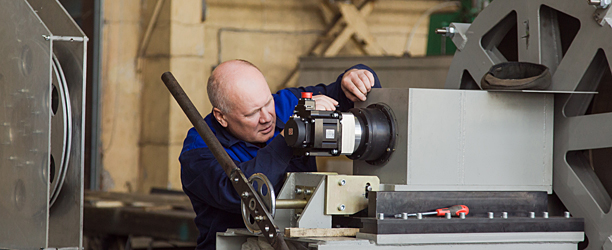
NIIEFA uses cutting-edge machines to manufacture the equipment, the institute underwent modernization. Under the federal target program tens of millions rubles were invested in the modernization. “Having such production site, we can easily start launching the series manufacture,” Andrey Strokach, the institute director general, comments. In the coming two years the institute is ready to manufacture five cyclotrons a year. In future, this figure can be doubled depending on the demand. There is an investment program. NIIEFA is going to sell cyclotrons not only in Russia, but also abroad, remembering the Soviet-Finnish experience.
“Our cyclotrons are easier to repair than foreign ones,” Strokach describes advantages of the design. To repair an imported machine one has to lie down on the radioactive target. In case of NIIEFA’s cyclotron, an engineer just moves the lid aside and can work without any harm for health.
“The next stage of the nuclear diagnostics development, and I think it is in the coming years, it will be the development of so-called strontium-rubidium generators. Isotopes for them will be produced at more powerful cyclotrons. It is not an easy task to design the generators. But they can be used longer than ultra-short-lived isotopes,” he says.
Pinpoint accuracy
One of cyclotrons manufactured in St. Petersburg was installed at NIITFA. Also, the series manufacture of equipment for PET-centers is planned to launch there. The new cyclotron weights 32 tons. To lower it to the basement, a hole was made in the roof and the huge machine was moved by the crane set up outside at random. The crane operator demonstrated pinpoint accuracy. The costly cyclotron (as much as RUB 60 million) was placed exactly where it should be. Now it undergoes adjustment and there is hope that it will work at full capacity already this year.
The isotope from the cyclotron will be sent to special shielded chambers in the radiopharmaceuticals synthesis room. Sources will be handled inside lead boxes. The operator will be able to control the process using a computer without contact with radiation. “We use domestic synthesis modules, Alexey Yadykin, the head of project office at NIITFA, explains. “Using glucose, it is possible to produce fluorodeoxyglucose marked by carbon-18. Glucose easily accumulates in cancer cells and as there is a radioactive part the problematic locations are clearly seen on the display of the machine.” This compound is used for 90% of nuclear diagnostics.
The top of the milk is the pilot PET specimen of own design. The thing that has never been made in Russia and that is the base of the positron-emission imaging center. “The solutions are ours, though with the use of the best foreign practices. We will license it,” Alexander Zhavoronko, head of laboratory at NIITFA, says with determination.