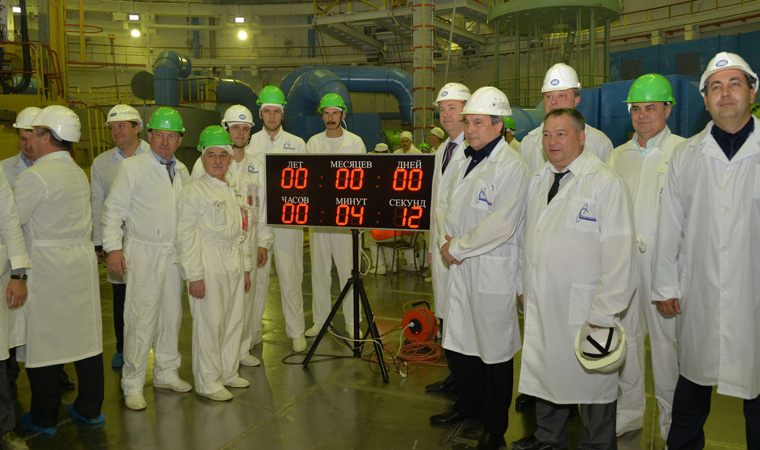
Valery Limarenko emphasized that Unit 3 was commissioned earlier than scheduled: “The decision to shift the dates made by the sector management was due to a high degree of completion. We successfully do the task set for us. This speaks about commitment to the result of all project participants and employees of the company, which today counts about 20,000 people.”
The first assembly
According to Limarenko, Multi-D system has helped achieve the outstripping rates: “This is the system of NPP design and construction management, which today is the standard not only here but also in all world countries where the engineering company NIAEP-ASE is present. This is out know-how and we stay clear in the market with its help.”
In the framework of the first criticality program 163 fuel assemblies will be loaded in the reactor core. After loading is completed, the reactor core will house 80 tons of low enriched uranium. The first criticality activities are to take 25 days and include bringing the reactor to the minimum controlled power. The next stage will be the first power and start of electricity supply. This is to happen on December 22, on the Power Engineer’s Day. Power unit start-ups are traditionally tied up to this date.
“The ambitious nuclear build program was approved in 2006,” Limarenko says. “The first power unit under this program was started up in 2009. It was Rostov-2. Then, Kalinin-4 followed and now it is Rostov-3. When Rostov-2 was under commissioning, we hoisted the national colors of Russia on elevation -4 on the third unit site to raise spirit of the people who worked there for them to see the future. And, literally, just in five minutes a new power unit appeared in this place, the first fuel assembly came in. There are dozens of thousands of people behind this first fuel assembly, those who took part in the process in different time and different cities: physicists and designers and architects and people who install the equipment and build and start-up and adjust and mine ore, enrich it and fabricate fuel. They not just coped with this work; they did it two months earlier than planned.”