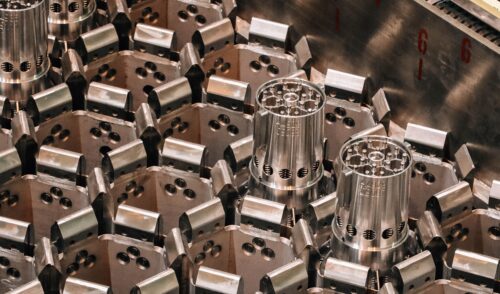
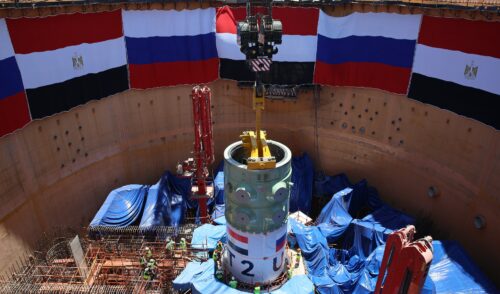
On November 17, the first of four test facilities arrived from Russia at the construction site of the International Thermonuclear Experimental Reactor (ITER). These will be used to test port plugs — special devices housing diagnostic and technical systems — in near-real conditions.
The port plug test facility is a 40-cubic-meter steel vacuum chamber weighing nearly 30 metric tons and equipped with vacuum, heating, control and monitoring systems. According to an agreement signed in 2011, Russia undertook to manufacture and supply four such facilities. The manufacturing company is the Mechanical Engineering and Instrumentation Group (GKMP). GKMP produces equipment for nuclear fusion, cryogenics, and thermal vacuum testing, and conducts complex equipment trials.
“This test facility is one of the most complex and technologically advanced systems within our scope of responsibility for the project. To engineer and manufacture it, our key suppliers had to develop and deploy advanced innovative solutions. Russia has been entrusted with the production of all the units, which is a result of our experience and technological leadership,” Anatoly Krasilnikov, Director of the Russian ITER Project Center (a Rosatom subsidiary), said at the ceremony marking the arrival of the test facilities.
Testing is essential
The vacuum chambers will be used to test all 46 port plugs produced by the ITER member countries. Deep vacuum and high temperature will be created inside them to carry out vacuum, thermal, and functional tests. Specifically, there will be three testing cycles with temperatures ranging from 20°C to 240°C. A helium leak test will be conducted at each stage to confirm the system is airtight.

Russian engineers will participate in commissioning the test facility at the ITER site. “We are responsible for supervising the assembly of the test facility and each of its subsystems, and for comprehensive integral testing,” Olesya Solovyeva, Director of the ITER Project Office at GKMP, told the Strana Rosatom newspaper. Earlier this year, GKMP began producing the second test facility. It is expected to be completed by the autumn of 2026. Following factory acceptance tests, it will be shipped to France in early winter. The third and fourth facilities will be delivered by the end of 2029, the deadline set by the ITER Organization.
Russian contribution
ITER Construction Project Lead Sergio Orlandi praised the Russian contribution: “As the construction project manager, I am very pleased that the first port plug test facility has been delivered from the Russian ITER Center. This test facility is a vivid example of Russia’s advanced manufacturing capabilities, ensuring that all deliveries for the project are on time, on budget, and with the quality required. I want to express my special gratitude to the Russian experts who supervised every stage of design, procurement, and assembly of the facility.”
Previously, Russian nuclear companies delivered superconductors, a poloidal field coil, and four gyrotrons to the ITER construction site. Production of other components is underway. All Russian-made equipment is delivered in full compliance with the reactor construction timeline. In total, Russian R&D institutes and companies are tasked with manufacturing and supplying 25 high-tech systems for the under-construction ITER fusion facility.
ITER is a project to build the world’s first new-generation international thermonuclear experimental reactor. The construction site is located near Marseille, France. The project’s mission is to demonstrate the feasibility and viability of using fusion energy for peaceful purposes, and to refine the related processes. Mastering fusion will secure energy for humanity for millennia to come.
Russia is an ITER Member Country alongside the EU, China, India, Japan, South Korea, and the USA. Rosatom’s subsidiary ITER Project Center functions as the Russian national ITER agency responsible for ensuring Russia’s in-kind contribution to the project.
Photo by: ITER, “ITER Project Center” in Russia