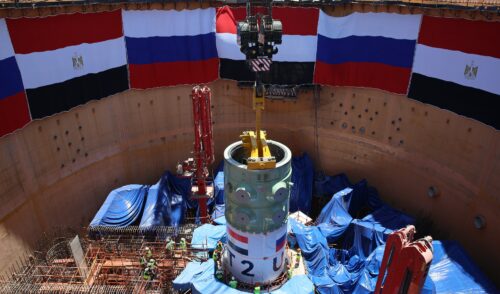
This year’s key milestone was passed at the El Dabaa NPP construction site as the reactor pressure vessel for Unit 1 was placed in its design position. The Presidents of Egypt and Russia congratulated the project team on this achievement. With a comprehensive cooperation program signed in November, the two countries are expanding their close cooperation in the nuclear field.
The 340-tonne reactor pressure vessel (RPV) for the power plant’s first unit was delivered to Egypt in late October. It passed the incoming inspection before workers proceeded with installation. First, the RPV was lifted from a horizontal to vertical position. Then, workers began lowering it into the reactor pit. All those operations were carried out using a heavy-duty crawler crane with a lifting capacity of 2,200 tonnes.
Finally, an official ceremony took place in late November to mark the installation of the reactor in its design position. Presidents Abdel Fattah el-Sisi of Egypt and Vladimir Putin of Russia congratulated the project team via video link on completing this crucial phase in the construction of El Dabaa Unit 1. International Atomic Energy Agency (IAEA) Director General Rafael Grossi also sent a video message to the event participants.
Rosatom Director General Alexey Likhachev noted that placing the Unit 1 RPV in its designated position was the year’s major milestone for the El Dabaa NPP project. “I am truly happy that we can celebrate Egypt’s Nuclear Energy Day with such a significant achievement, marking one of the key stages in the construction of the first Generation III+ unit on the African continent. Construction work at each of the four power units is in full swing, with more than 30,000 people involved,” Likhachev pointed out.
The reactor pressure vessel is a key component of the reactor unit, housing the core in which the controlled chain reaction occurs. It is leak-tight, withstands high pressure and temperature, and guarantees the safety and reliability of the power unit.

Cooperation continues
Rosatom and the Egyptian Ministry of Electricity signed a comprehensive cooperation program. The document establishes framework cooperation procedures and opens up new areas of joint effort. The program focuses on strengthening the strategic partnership between the countries, and provides for the development of economic collaboration and the expansion of cooperation between specialized organizations of the two states. Particular attention is paid to the exchange of experience and scientific and technical collaboration, laying a sustainable platform for a long-term partnership. The initiative aims to create conditions for launching promising projects and the comprehensive development of key sectors of the Egyptian economy.
“Russia and Egypt are consistently strengthening economic ties and creating infrastructure for the exchange of technological competencies and for local sourcing, which will promote investment growth, job creation, and higher competitiveness,” Alexey Likhachev said.
Cooperation between Egypt and Rosatom is closely linked to key aspects of Egypt’s Sustainable Development Strategy: Vision 2030. The El Dabaa NPP project is the primary, but not the only, field of joint work. Specifically, Rosatom supplies low-enriched nuclear fuel components for Egypt’s second research reactor, ETRR-2.
Business ties
Rosatom is expanding cooperation with Egypt at every level, including by way of strengthening business ties. In November, the Russian nuclear corporation participated in the Smart Transport, Infrastructure, Logistics and Traffic Expo and Conference (TransMEA 2025), Egypt’s leading regional platform for discussing innovation, technology transformation, industrial development, and sustainable mobility.
Rosatom presented a diversified portfolio of its technological solutions extending far beyond nuclear energy. This includes, for instance, a comprehensive additive manufacturing ecosystem that comprises development of new materials, engineering software, advanced 3D printers, and industrial applications, as well as energy storage solutions, including lithium-ion batteries and modular systems.
“Egypt is a strategic partner, and our cooperation spans several decades and is embodied in the El Dabaa NPP project. Building on this solid foundation, we continue to develop our partnership in advanced technologies that complement the achievement of Egypt’s national goals, from additive manufacturing that increases production efficiency and accelerates production processes to energy storage systems that enhance the reliability and efficiency of power supply,” said Murad Aslanov, Director of Rosatom’s office in Egypt.
Photo by: ASE JSC, Rosatom State Corporation