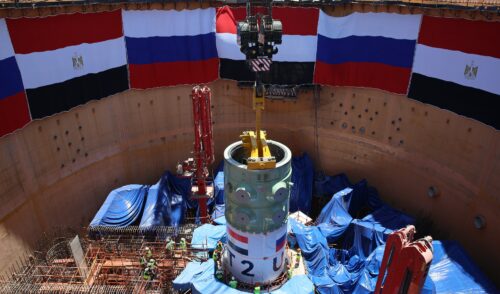
The reactor pressure vessel (RPV) for Unit 4 has been delivered to the Akkuyu NPP construction site. This is the last of the four reactors for the Turkish power plant, with the other three already installed. Staff training is continuing alongside construction as a new group of Turkish students have begun studying for nuclear professions at Russian universities.
In addition to the reactor pressure vessel, a containment airlock for Unit 3 and a pressurizer for Unit 4 were delivered to the site. The equipment was shipped using various modes of transport. The RPV was delivered to the pier from the manufacturing plant on a self-propelled platform, after which the vessel traveled over 3,000 kilometers by sea to arrive at the Vostochny (Eastern) cargo terminal of the Akkuyu NPP site.
“The reactor pressure vessel is a key component of a nuclear power unit. This is where the controlled chain reaction occurs during plant operation. The reactor is also called the heart of the nuclear power plant. To date, the same pieces of equipment have already been installed at Units 1, 2, and 3. The arrival of the RPV for Unit 4 means that we have completed the delivery of reactors for all four units of the Akkuyu NPP,” said Sergey Butskikh, CEO of Akkuyu Nuclear JSC.
Made of high-strength heat-resistant alloy steel, each reactor pressure vessel is about 13 meters long and 4.5 meters in diameter, and weighs 320 metric tons. The service life of the reactor is 60 years, extendable to 80 years.
The Unit 4 RPV will be mounted using the Open Top technology, which involves lowering heavy equipment into the containment area through the open top of the reactor building’s cylindrical section. This technology optimizes construction and installation operations at the power unit.
Nuclear knowledge for everyone
In late November, a new group of 56 students began their master’s studies at four Russian universities. The students were selected from bachelor’s graduates of relevant Turkish universities based on academic performance and the relevance of their prior education. All candidates passed entrance exams, including interviews with professors from the participating universities. These master’s studies are part of a broader staff training program for the Akkuyu NPP.

During the first year, students will study the Russian language to the level necessary to master specialized disciplines, after which they will continue training in their respective specialties, such as nuclear physics, thermal engineering, power engineering, and electrical engineering.
“Each student cohort is a step forward in preparing the team that will operate the first nuclear power plant in Türkiye. The new group of students has already started their course. Broad prospects for professional development in nuclear energy are opening up for them. Our future colleagues will receive fundamental knowledge at the best Russian technical universities and, when working at the Akkuyu NPP, will be able to apply it in practice. We will support students at every stage, from adaptation in Russia to assignment to Akkuyu Nuclear departments,” noted Sergey Butskikh.
Along with training industry personnel, Rosatom is engaged in promoting public awareness of the nuclear industry. In November, the Russian nuclear corporation held its Global Atomic Quiz for the sixth time. This year, about 46,000 people from 106 countries took part in the international educational quiz. In Türkiye, the in-person part of the quiz was organized at Hacettepe University: over a hundred students from different departments gathered to take the test simultaneously. This year’s quiz was dedicated to the 80th anniversary of the Russian nuclear industry and covered the past, present, and future of nuclear technologies. Topics included the history of the industry, latest innovations, and development prospects. Contestants learned through questions and explanations how nuclear technologies are applied in many different areas.
“Global Atomic Quiz questions spark interest in nuclear science and provide new knowledge. Even students without a specialized background tried to answer them using logic. Among the questions were those showing that nuclear technology is not about electricity production only but is applied in very different fields for the benefit of humanity. I especially liked the question about fast neutron reactors. Such reactors operate in Russia, and, in my opinion, they are what will make nuclear energy clean and virtually inexhaustible,” noted Professor Şule Ergün, Head of the Nuclear Engineering Department at Hacettepe University.
Photo by: Akkuyu Nuclear JSC