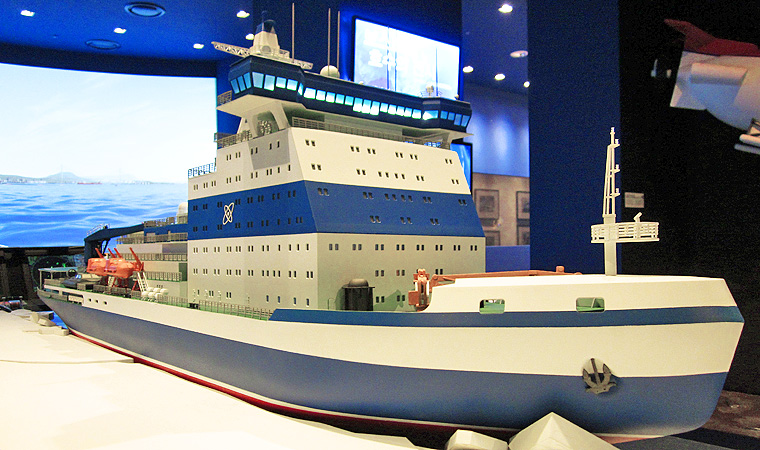
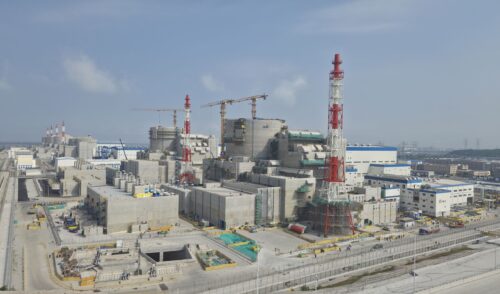
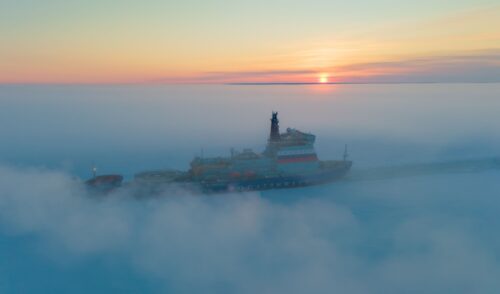
The project of the new icebreakers of LC‑60YA type construction is extremely important for maintaining the advantages of Russia in Arctic, as the current nuclear icebreaker fleet is aging rapidly: by 2017 only two vessels will remain in service. “The Northern Sea Route cannot do without atomic icebreakers, meanwhile the existing icebreakers are to be decommissioned in the coming years,” – says the first deputy head of Rosatom Ivan Kamenskih.
According to experts the turnover in the northern transportation arteries will only grow each year. Today nuclear-powered ships are being used more and more often to solve problems of national importance: the definition of the continental shelf borders in Arctic, providing work for polar stations. This is not to ignore the transportation functions, for which the atomic icebreaker fleet was initially built. Nuclear-powered ships have been giving way to cargo ships to the Far North for the last decades.
The draft of a new vessel was designed by the “Iceberg” Central Design Bureau. Almost 37 billion rubles will be allowed for the first icebreaker construction. The launching is scheduled for November 2015, ice testing will take place in November 2017, while the delivery of the vessel to the customer in Murmansk is scheduled for December 30, 2017.
However it all won’t limit up just to one icebreaker. Russia will retain a need for four or five ships for a long-term of 15–30 years. This will require two more LK‑60YA to be built with a serial shift of two years, along with the continued operation of the icebreaker “50 Years of Victory”.
Half-Seas-Over
The new icebreaker will receive Ice Class of Icebreaker 9, the one of the highest. This means that the ship can carry out icebreaking operations in arctic seas in winter-spring period with the ice thickness of 4 m, and without restrictions in summer-autumn term. However no tourists would be allowed on LK 60YA, as no room for them was ever designed.
The new icebreaker will be versatile, it will be able to travel both by sea and rivers. The vessel dual draftness will be provided by a special ballast system that will change the draft due to dewatering. Ballast tanks are located below the water line and filled by gravity. As a result of this the draft of vessel is 11 meters – the amount necessary for crossing the sea to land. When LC‑60YA approaches the mouth of the rivers the powerful pumps will go off. They will pump out the water, which would increase up to 8 meters as a result of the draft, in only six hours. This will allow the vessel to continue its journey in the shallow water. The dual draftness itself is not uncommon in the shipping industry, but it’s the first time this technology is used for an icebreaker.
The length of the LK 60YA vessel will be 173.3 meters, full height – 15.2 meters, displacement – 33.5 thousand tons. The width of 34 m ensures that the vessel can be easily accompanied by a tanker with the carrying capacity of 100 tons. The power level will be 60 MWt. The speed with the W’r up to two points should reach 20 knots, which is about 38 km/h. Cruising range is not limited.
Step by Step
Three major steps can be named while constructing a new icebreaker. The first one is the hull assembly. Special attention is paid to the particular increase in the water line, the so-called ice belt that provides abrasion resistance and protects the compression in the ice fields. Siding in the ice belt area and adjacent areas should be made of high-strength steel. The thickness of the ice belt is 36 mm in the middle part, 52 mm in the forward and 44 mm in the afterbody of the ship.
The second stage – the outfitting of the hull, that is accommodation of the reactor and other equipment. The ship will also possess a new power plant of the RITM‑200 generation, designed by Experimental Mechanical Design Bureau “Afrikantov”.
And finally the third part – assembling and installing of three giant engines designed by the French company “Converteam”. Almost all major passenger cruise liners in the world are equipped with its motors.
About 3.5 thousand specialists of the Baltic plant and approximately 100 allied enterprises will be involved in the construction of the new vessel. In general, according to Artem Pidnik, a vice General Director of the “Baltic Shipyard – Shipbuilding” LLC, a project realization will involve 50 thousand specialists of various categories. “This will allow us to revive the tradition of Russia in nuclear-powered icebreakers construction field” – he pointed out.