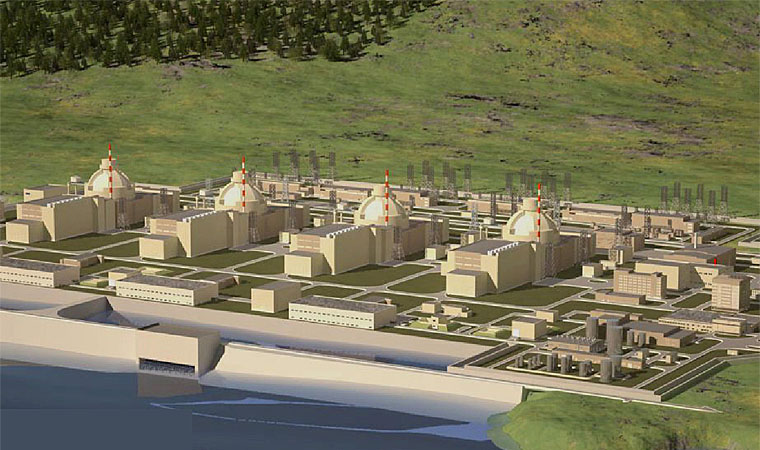
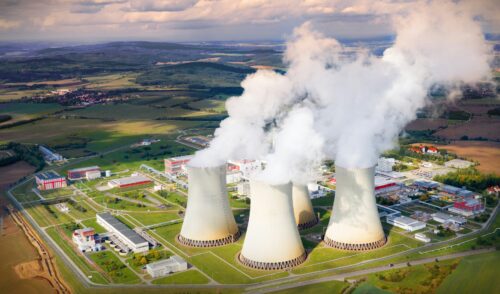
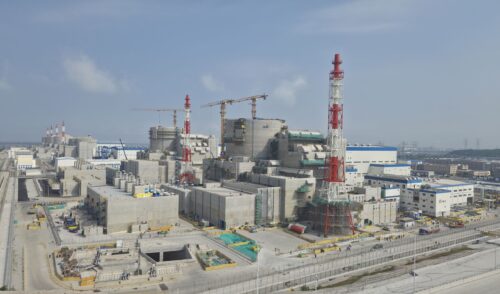
The four power units construction with the VVER reactors at the Akkuyu NPP in Turkey is gaining speed. At the end of February the first contract for installation and construction works was signed. The document was signed by the Branch of Atomstroyexport (ASE) in Turkey, represented by Alexander Mironov, and Murat Kavak , the representative of the Turkish company OZDOGU Insaat ve Ticaret Ltd.Sti, selected as the contractor through the bidding process.
The contract covers the excavation of a pit on Akkuyu NPP site, reprocessing of rock for the use in construction and site leveling. It is planned that about 4.5 million cubic meters of rock will be reprocessed in the course of the work. Let us remind the readers, that the Agreement between the Government of the Russian Federation and the Government of the Republic of Turkey concerning the construction and operation of an NPP was signed in May 2010.
According to the intergovernmental agreement, Atomstroyexport is the prime contractor for construction of the nuclear power plant. The project of Turkey’s first NPP includes four VVER reactors. Power capacity of each NPP unit will be 1200 MW. Akkuyu NPP construction is planned to be on BOO (Build-Own-Operate) terms. The construction of the four-reactor NPP in Turkey will allow producing about 35 trillion kWh of electricity per year. The first power unit is planned to be ready by the end of 2019, while the whole project is planned to be completed by 2022. Currently there are more than 100 Turkish students being trained for the further work at the Akkuyu NPP.
The Cooperation will Continue
Rosenergoatom Concern continues its cooperation with one of Europe’s largest utilities, Iberdrola (Spain). The other day the parties had a meeting at the Baltic NPP site, where they discussed the prospective of their further cooperation. Before the working meeting the committee members took a tour of the Baltic NPP site.
In the Construction Directorate of Baltic Nuclear Power Plant the guests were briefed on Russia’s advanced designs VVER-TOI and AES-2006 (this design is used for Baltic NPP). Vitaly Trutnev, the Chief Engineer of the Construction Directorate, noted the guests had been interested, in the first place, in differences of the Russian designs from European ones. “One of the main differences is the use of passive safety systems in our designs.
Today, the issues of safe operation of NPPs are the issues of the cooperation of those who operates NPPs rather than issues of competition,” Vitaly Trutnev said. In the course of the meeting the Spanish guests demonstrated operational principles of their company and confirmed their interest in the Baltic NPP (the plant may become the first Russia’s nuclear project with a foreign investor’s participation).
“We think that in the nearest future our participation in the external, foreign market will be limited to Great Britain. However, we keep interest to Baltic NPP and trace the construction progress with a great interest,” said Joaquin Suarez, Director for Nuclear Power in Iberdrola. On the second day of the stay of the Russian-Spanish delegation in the region, that time in Kaliningrad, a committee meeting was held, which summed up results of the Russian-Spanish cooperation in 2012 and refined plans for 2013.
“New systems, which increased warranted safety of nuclear power units, have appeared. At this meeting we share our experience. We demonstrate the approaches which we apply and which are applied by them. We supplement and assist each other in entering a higher safety level,” Nikolay Davidenko, Deputy Technical Director of Rosenergoatom, commented on the meeting.
The large interaction program includes the involvement of the Spanish specialists in review of Russian designs, the participation in processes related to upgrading and decommissioning of power units, the continuation of implementation of high-precision ultrasonic flow meters at the Russian nuclear power plants.