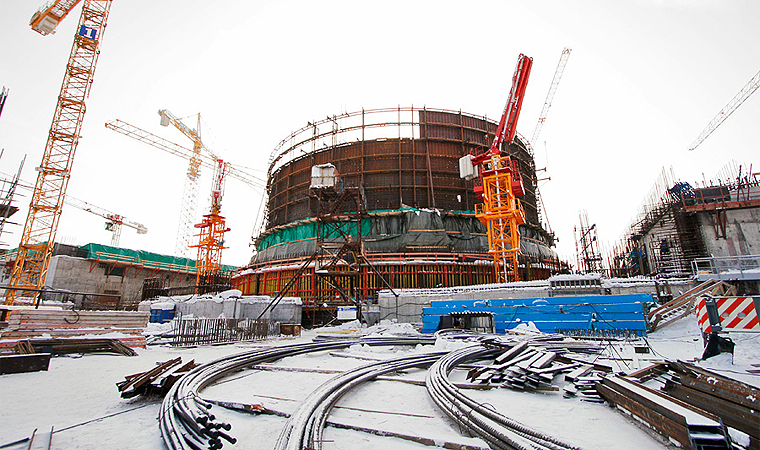
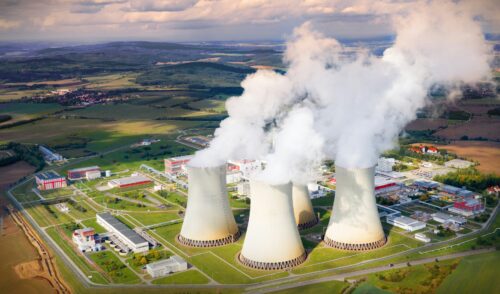
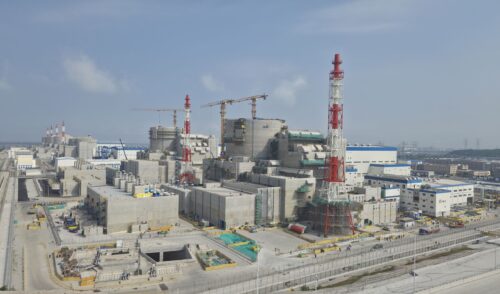
Back in 2006 Rosatom made NPP serial construction its objective, restoring the pace of the Soviet time. Today we can say that the goal is being achieved successfully, since the nuclear power, being the country’s “main locomotive of economic development” is confidently moving forward. During the last three years in Russia two new power units were launched – at the Rostov and Kalinin NPPs. The construction is in progress at five sites. Recently the replacement capacity projects of the Kursk and Smolensk-2 NPPs were added, these days the preparation work is going on. We took a closer look.
Two power units today are being constructed near Voronezh. At power unit 1 of the Novovronezh NPP-2 they are about to start pile assembly mounting. The mounting of the core melt trap was completed at power unit 2. The same situation today is at power units 3 and 4 of the Rostov NPP in Volgodonsk. At power unit 4 the energy supply for their own needs will begin soon.
The first concrete pouring was conducted at the Leningrad NPP-2 near Saint-Petersburg and Baltic NPP in Kaliningrad region. The work at the power unit with the BN-800 fast breeder reactor at the Beloyarsk NPP is in progress: they started the steam-generator assembly preparations. Soon the active phase of construction will start at two more sites: Kursk NPP-2 and Smolensk NPP-2. General Contractors and Designers are already known, as well as the sites. Preparatory works are being done.
Mounting Done!
The pace of construction, the personnel and the cost of NPP – those must be the key problems, being constantly solved by all the world players of nuclear power sphere. Various technology concepts helping to optimize the speed of construction are being successfully applied at the Russian sites. Thus, installation of prefabricated subassembly is being conducted at the Novovoronezh NPP-2 in Voronezh region.
Previously the project suggested that all the capping beams will be installed on site. However it was decided to switch to prefabricated subassembly, which allowed to speed up the pace of work. “This method is used for building houses: the beams are put, forms are installed and then concrete is poured”, – says Leonid Egorov, the First Deputy General Director of Atomenergoproyekt, Rosatom engineering company. – Prefabricated subassembly allows us to reduce construction time and cost. Operations being conducted while in plants, not at site, permits increasing the quality of assembly. At the first unit of the Novovoronezh NPP-2 our reinforced concrete block was doubled, while at the second one we united four elements”.
The same technology is being used at the Leningrad and Baltic sites. The other idea helping to speed up the process is applying of union joints instead of welding. “Bar grip mechanical splices and sleeve-nuts let us avoid a big number of highly-qualified welders, raising the quality of work at the same time”, – explains Egorov. At some hard to reach areas a special type of concrete is used, which gets contracted with its own mass without any additional manipulations.
Taking care of the personnel
It goes without saying that technology is important, however one cannot expect a real break-through without some highly qualified personnel. Among all, the safety depends on the competence of constructors. This is the main concern of self-regulated organizations (SRO) of the nuclear industry. Thus, a center for professional training of nuclear industry workers (NOU UCPR) with its branches in Moscow and Novovoronezh, is planned to be opened, as said at the annual meeting of the members of the organization Victor Opekunov, the SRO President.
According to him, the training centers have to give direction for the renewed system of qualified personnel training on the most demanded profiles in the industry. Thus, this year it is planned to start the center of industry demand prognosis in personnel and types of work, the digital system of qualified personnel monitoring will start operating. It is planned to spend RUB 20 million for executive personnel training, while for the administrative personnel RUB 50 million are offered.
3,000 people are planned to be trained within the limits of continual professional education. Besides, starting from this year the SROs will hold tenders for the best engineering company, the best research, construction and contractor organization, says Opekunov.