Recently it has been included into Russian energetic system – for now in a test mode, but the success of the tests makes us expect the station to work at its full power shortly. Rosatom is developing its non-atomic projects. The corporation has both its own equipment suppliers and engineering companies, ready to offer services on a turnkey basis. That’s why Atomstroyexport, later included into NIAEP-ASE, in 2009 took part in the open tender for the Yuzhnouralskaya GRES-2 and won it. Three years later they decided that units 2 and 3 would be constructed by the same company. The latest events at the YUGRES prove the industry’s enterprises to have significant experience and great technical capabilities not only in atomic but also in traditional sphere.
Successful tests
Synchronization of a unit with grid is a highly important step of pre-commissioning activities on the site. “It showed that all systems of unit 1 are ready to work and that pre-commissioning was done well, – said Pavel Khudiakov, Deputy Director for Production of the NIAEP-ASE, Yuzhnouralsk branch. – generating equipment is registered in Rostechnadzor and is filed in Regional Dispatching Office”. On November 15 the unit took its first test load – 60MW. Its total capacity is 420 MW.
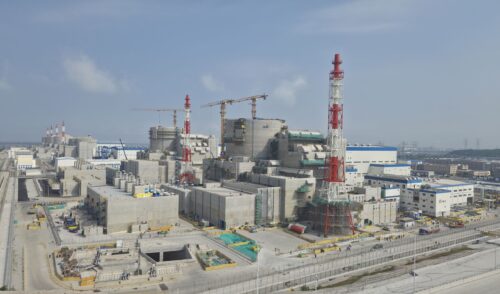
Two units of the YUGRES-2 are being built at a distance of 5 kilometers from the Yuzhnouralskaya GRES (Cheliabinsk region), now under operation, on the left shore of the river Uvelka. The object was one of the thermal power pioneers of the Soviet Union. It has been providing energy to South Ural and thermal power to industrial enterprises and regular consumers of Yuzhnouralsk without any problems since 1952. However many things have changed in 50 years: the region’s population is growing, industry is developing. In 2008 the OKG-3 board of directors (YUGRES is subordinated to it) made the decision to build extra power.
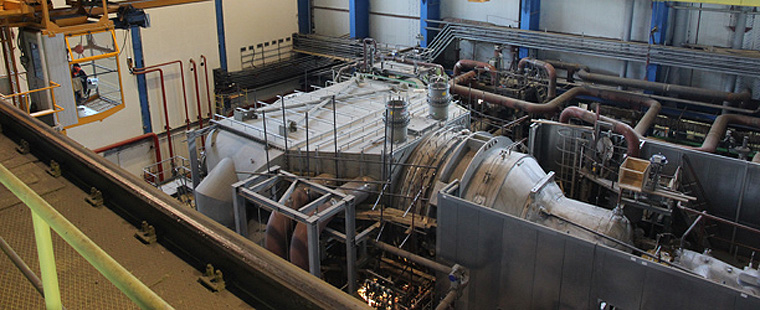
The NIAEP-ASE specialists are building the YUGRES-2 power complex upon EPC-type contract (engineering, procurement, construction). This contract has a fixed price and fixed deadlines; according to it a contractor takes all the responsibilities and risks concerning the object. The clients’ demands say the YUGRES-2 should be a combined cycle electric generating condensing plant consisting of three units with total power of 1200 MW (3 units 400 MW each) with additional buildings and communications. Each unit consists of one SGT-4000F gas turbine system, one exhaust-heat boiler and one SSТ-3000 condensing steam-turbine plant.
Plans for abroad
NIAEP-ASE is planning to complete the combined testing of unit 1 as early as by the end of the month. “The preparation for combined testing is going round the clock, – says Pavel Hudiakov. – The next stage is steam purge of exhaust heat-boiler under up to 100MW load; dynamic tests of combined-cycle plant with guaranteed power gain up to 420 MW”. The first unit is planned to be delivered to the client by the end of this year, two more – in the third quarter of the next year.
Meanwhile there is information that Rosatom is willing to take part in another thermal power project, this time abroad. Rusatom Overseas has filed an application for the construction of the Pljevlja TPP unit 2 in Montenegro, according to RIA Novosti. The country incurs deficit of electric energy which now it has to import. There is just one TPP operating in Montenegro (the one in Pljevlja) and two HPPs. The project to win the tender is promised to be the one with fewer risks and better combination of financial, ecological and commercial characteristics. Besides Rusatom Overseas the following companies have filed their offers: a consortium from Poland (POL-MOT, Alstom, Foster Wheeler), Skoda Praha (Czech Republic), Slovakian consortium (Istroenergo Group IEG Slovakia-SES Tlmace) and five Chinese companies. According to local mass media, the most expensive offer, costing EUR 520 million, belongs to the Polish consortium, the cheapest one, costing EUR 210 million is from Chinese companies.