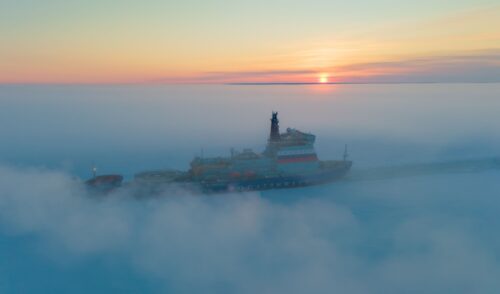
This July marks the anniversary of the nuclear icebreaker Vaygach’s Arctic service. Over 35 years, it has escorted ships through polar waters and rescued them from icy traps. Here are some of the most fascinating facts about this remarkable ship’s design and history.
The icebreaker bears the name of a 20th-century hydrographic vessel that worked in the Arctic, which itself was named after the island straddling the Barents and Kara Seas.
Vaygach was built to address the need for icebreakers capable of operating in both the seas of the Arctic Ocean and estuaries of Siberian rivers, particularly in the lower reaches of the Yenisei River where the Nadezhda Metallurgical Plant and other production facilities of the Norilsk Industrial District were being built in the 1970s. The ice thickness near Dudinka, the key transportation hub on the Yenisei, reaches up to 1.4 meters, making it impossible for ships to move during cold months without icebreaker assistance. Diesel-powered icebreakers were operating at their limits, while existing nuclear-powered vessels had too deep a draft for the operation in the river estuary.

Soviet engineers developed Project 10580, a new design producing two icebreakers, Taymyr and Vaygach. These ships feature typical icebreaker hulls with an arched stem and sloping sides to reduce ice pressure from compressing ice fields, and improve maneuverability. But unlike other icebreakers, their hull bottom is flat rather than egg-shaped. All critical systems were duplicated for reliability. The ships are equipped with an air-bubbling system: compressed air released through nozzles below the waterline lubricates the hull, reducing friction with ice and improving performance in severe conditions. Each vessel carries one KLT-40M reactor. Vaygach differs slightly from Taymyr: the former has two pairs of wedge-shaped runners on the bottom to divert broken ice. Thanks to this feature, less ice gets into the propellers when passing through ice fields, and the channel Vaygach makes is cleaner than that of Taymyr. Special high-strength steel with high impact toughness at low temperatures was used for the hulls of both icebreakers. All key components, including the nuclear reactor, main and auxiliary turbines, emergency diesel generators, auxiliary boilers and more, were manufactured and installed in the Soviet Union.
Taymyr was laid down first, in January 1985, followed by Vaygach in 1987. The flag was raised on Vaygach on March 6, 1989. It was commissioned and joined the Murmansk Shipping Company on July 25, 1990, and began working in the Arctic. It operated in the Yenisei Gulf, navigated the Yenisei River, worked in Ob Bay, in the eastern and western sectors of the Northern Sea Route, in the White Sea, and the Gulf of Finland.
Vaygach has taken part in numerous rescue operations, delivered essential equipment and personnel, and performed many other critical tasks.
One of its most famous missions occurred in spring 2011 in the Gulf of Finland, when nearly 150 ships were trapped in unusually heavy ice for that time of year. The ice that formed over winter did not melt as expected. Ships trying to move churned the ice into slush, only getting stuck deeper. The ‘traffic jam’ started near Gogland, one of the islands in the gulf. Diesel icebreakers could not cope with the task, so Vaygach was called in for help. Complex convoy patterns had to be organized, with the icebreaker often working within meters from stranded ships. Vaygach operated nonstop for six weeks.
In late 2021, Vaygach again proved its worth when 24 ships became trapped in the ice due to a combination of factors. Two other icebreakers, Yamal and Taymyr, also assisted in freeing the vessels, but Vaygach took on the largest share of the task. It escorted a convoy of eight ships (many more than the usual one or two ships per icebreaker) through the eastern sector of the Northern Sea Route, including through the most challenging areas.
In May 2024, Vaygach conducted flood prevention operations on the Yenisei River, destroying old ice channels, cutting ice jams, and making additional ice channels on the river to prevent ice jams and damage to the Dudinka port infrastructure. On July 2 of the same year, Vaygach opened the summer navigation season by escorting three ships carrying petroleum products and various cargo as part of supply deliveries to Russia’s northern territories. Today, Vaygach continues to operate on the Northern Sea Route, ensuring safe passage for ships.
Photo by: Anna Nikolaichik, Dmitry Efremtsev