Russia is a key player in the global quantum market. Russian scientists have achieved remarkable success, having created quantum processing units with dozens of qubits and running the first calculations for model problems. Rosatom is in charge of the national roadmap for quantum computing development and is building alliances with Russian and international partners.
Computing speed is the main feature of quantum computers that makes them potentially much more promising than classical computers. The minimal unit of information handled by quantum computers is a qubit. While two classical bits can take only one of four values at any given moment (00, 01, 10, 11), two qubits can be in all these states simultaneously — a phenomenon known as superposition.
Quantum parallelism is based on this fundamental feature. A classical computer can execute an algorithm for only one set of input data at a time. A quantum computer, if fed a superposition of all possible input values, will perform the operation for all of them at once. Thanks to the superposition and the resulting parallelism, quantum computers are capable of performing calculations much faster than ordinary computers. The larger the quantum processing unit, the higher the parallelism: a system of n qubits in superposition is in all 2n states simultaneously.
Because of this, quantum processing units are particularly effective for specific types of calculations. These include, for example, tasks involving sorting through many options to find optimal combinations with a large number of parameters. Applications range from pharmaceuticals and materials science to logistics and cybersecurity. Solutions to such problems are needed for the development of artificial intelligence, the creation of ultra-precise clocks, the optimization of production processes, and more.
For now, the first attempts are being made worldwide to use quantum processors to solve real-world tasks. There have already been isolated successes.
Russia’s place in quantum technologies
Russia is one of the few countries creating quantum computers on four physical platforms: ions, cold atoms, superconductors, and photons. Most countries develop only one or two platforms.
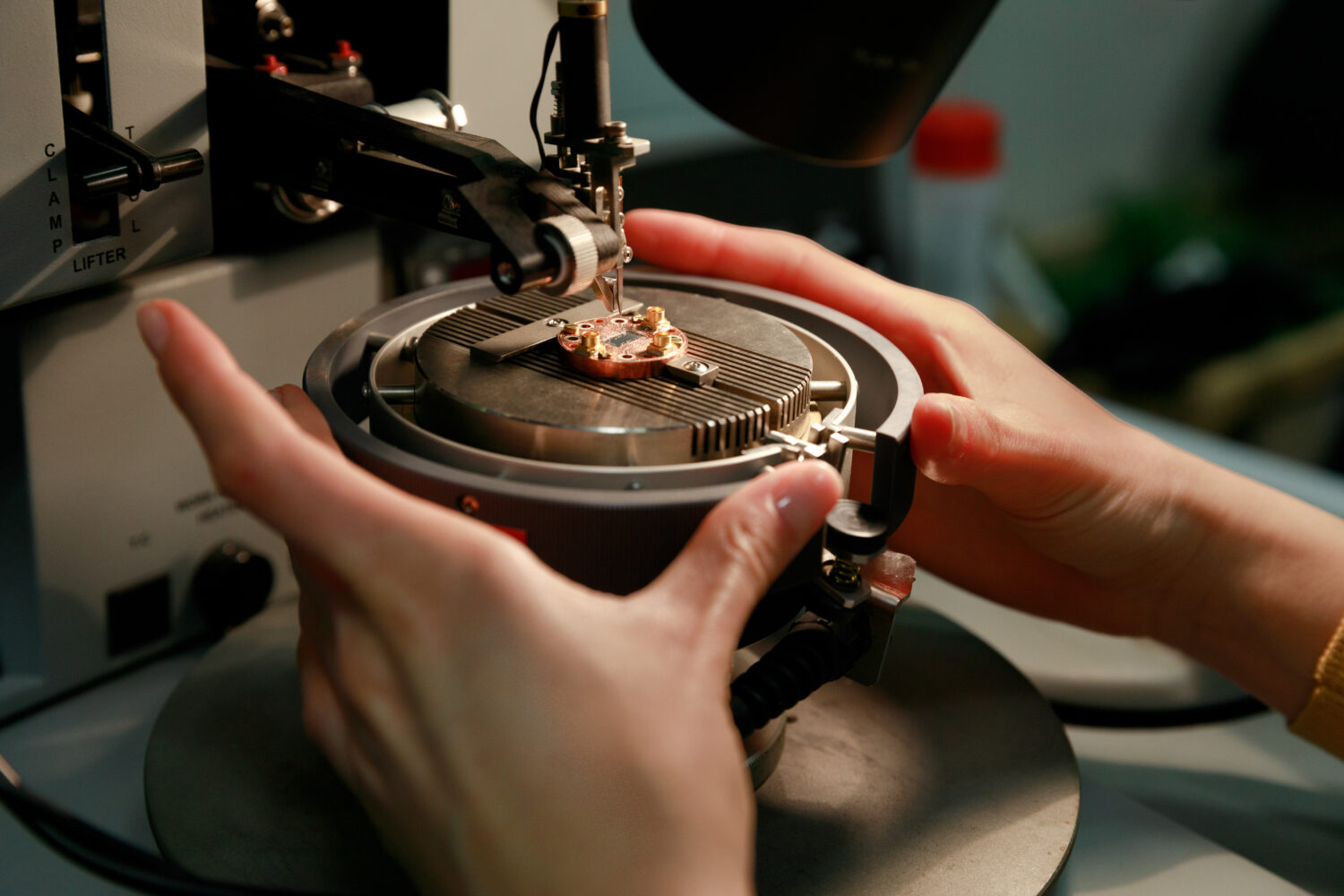
Russian scientists have achieved remarkable success in creating quantum processing units. For instance, a 70-qubit computer has been created using ytterbium ions. Computers based on calcium ions and cold atoms have reached 72 qubits. There are 16 fluxonium qubits in a superconducting processor and 35 in a photonic one.
Another important area is quantum software — special algorithms for solving practical problems. Russian scientists have developed 43 algorithms. Seven nuclear industry organizations are testing quantum algorithms at their facilities to solve model problems. For example, a model heat transfer problem was solved for the Proryv (Breakthrough) project, which involves building a Generation IV power production facility with a closed nuclear fuel cycle. The calculations were performed on a 50-qubit ion quantum computer using a cloud quantum computing platform.
In total, the portfolio includes seven projects for optimizing production processes, twelve for solving problems in modeling, and four projects related to data analytics.
International interest
About ten countries are showing interest in the Russian developments in quantum computing. This is unsurprising given the rapid speed of development of these technologies in Russia (ten years ago, the country did not have a single quantum processing unit even with a couple of qubits) and their development efficiency. Ranked 11th in the world in terms of government program funding for quantum computing, Russia has shown some of the highest tangible results and is approaching the leaders, the US and China. To this, one should add the breadth of capabilities: research teams from national universities and research institutes participate in the development of quantum computers, allowing, for example, the simultaneous development of ion processors based on both ytterbium and calcium.
Russia and, of course, Rosatom are ready to expand cooperation in the quantum field with other countries. To facilitate this work, Rosatom, the Ministry of Science and Higher Education, and the Ministry of Digital Development, Communications and Mass Media will hold the first BRICS Quantum Technologies Forum in Moscow in April 2026.
Representatives of the scientific community, government authorities, and business from the member countries and partner countries are invited to participate. It is expected that the single cooperation space within BRICS will accelerate the development of applied quantum solutions and strengthen the organization’s position as a global technological hub.
“In 2025, our scientists confirmed the country’s stable position in quantum research and the development of quantum computer prototypes. With the high potential we have, we strongly advocate fair and open access to advanced technologies because the ultimate goal of scientific and technological progress is to improve the quality of life worldwide,” commented Ekaterina Solntseva, Director for Quantum Technologies at Rosatom.
Photo by: Faculty of Physics Media Center, MSU; Strana Rosatom newspaper