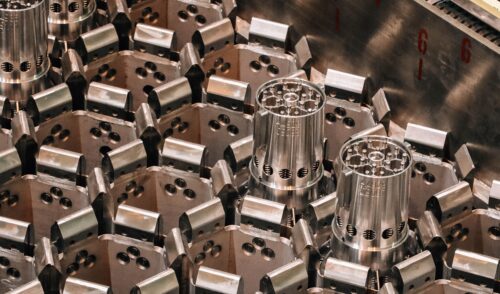
The famous HEU-LEU contract is over; four last containers with LEU were sent from the port of Saint-Petersburg in the middle of November and arrived to Baltimore in December. Further the containers are to be sent to Padukah port, KY, to the USEC gas diffusion plant, Rosatom’s partner in the program. Then the uranium will be used for fuel production for companies operating NPPs. As we remember, 500 tons of HEU from the Russian nuclear warheads (equivalent to 20,000 nuclear charges) had been recycled and delivered to the USA as fuel for U.S. reactors.
Trust-based
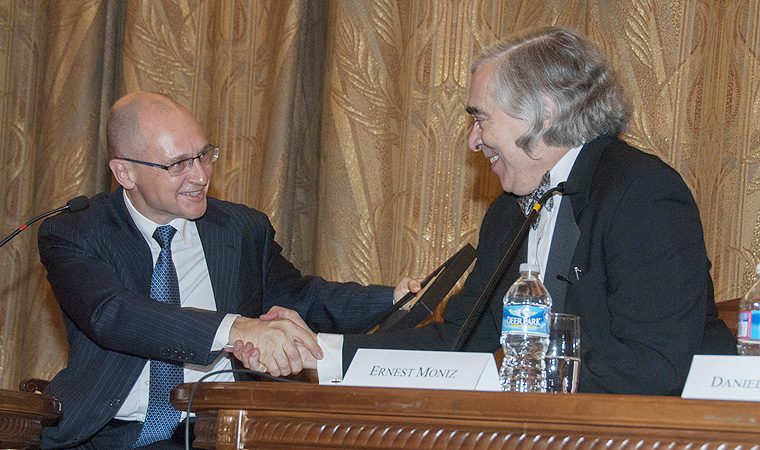
“Our industry lives in long cycles. This makes us not only do long-term planning, but demands high degree of trust to partners. The trust makes us confident that the agreement really is going to work for such a long period of time. The HEU-LEU contract realization is a unique experience of trust in a very delicate and complicated sphere”, – commented Sergey Kiriyenko at an event dedicated to the program completion.
Dan Poneman, Co-Chairman of the Working Group on Nuclear Energy and Nuclear Security, considers himself very lucky: he not just took part in the HEU-LEU program start-up, but also in striking balance to it. ”Today the program seems to have been historically inevitable, however at the very beginning we were not so sure about it”, – he recalls.
The first person to put the beginning to the partnership was Dr. Thomas Neff from the Massachusetts University of Technology, with his article written for New York Times where he first expressed the idea of transforming megatons of weapons-grade uranium to megawatts of energy. “Some people saw the idea as crazy back then. How can you make fuel from weapons? But then we thought better and decided that was possible”, – continues Mr. Poneman. As a surprise to many American experts, the idea was supported in Russia.
Rosatom prepared to the program completion in advance. TENEX has already made contracts for LEU supply for American energy companies from 2014 to 2025 for the sum of more than $5,5 billion. “And we keep discussing our joint programs”, – added Mr. Kiriyenko.
Perspectives
This was the subject of the dialogue between the Corporation’s General Director and the US Energy Secretary in Washington D.C. “We made a list of promising projects, such as technical plans of nuclear non-proliferation, cooperation in different spheres of science. And this is just the beginning of the list”, – referred Ernest Moniz to the negotiations.
“Today we’ve spent a lot of time speaking about promising directions in frames of intergovernmental agreement for scientific partnership. Made some patterns of mutually profitable interrelation, among all there is a multipurpose fast research reactor project too”, – said Sergey Kiriyenko. In his opinion “today it is too early to say how much time the mutual projects will take at the reactor, today we should rather understand, what kind of projects could it be”.
Mr. Poneman, in his turn, noted that the existing list of directions of possible partnership in nuclear science is quite vast. “Today we together with Mr. Kiriyenko decided to address to the leading experts of our countries so they could choose the most promising projects for the partnership”, – he said.
In September there was an Agreement on Scientific and Technological Cooperation signed in Vienna between Rosatom and the US Department of Energy. For now the parties continue discussing possible directions of partnership. The result might be clear as early as the next year.