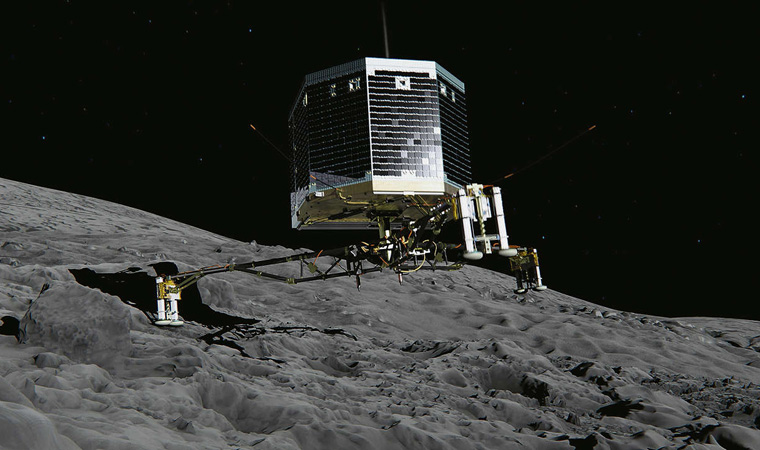
We mean landing of the Philae module on the comet’s nucleus surface, which happened for the first time in human history. The detailed study of the Churyumov-Gerasimenko comet became possible due to the work of NIIAR (Scientific Research Institute for Atomic Energy Reactors).
The analysis of the ground contents is possible due to alpha-particles and X-ray spectrometer APXS, a part of which is the NIIAR “child”- curium-244-based radiating sources. Due to the so-called secondary radiation, the source based on curium-244 creates secondary gamma-emission, allowing to find out what substance the rock consists of.
Preparations to the Rosetta spacecraft mission started as far back as 1993. That time NIIAR was awarded a contract to produce curium-based sources.
The Philae module of Rosetta cosmic plant for the first time in the history landed on the comet’s three kilometer nucleus on November 12, after 24 hours starting to study its chemical composition. As a result of studying the vapor of the comet they found out, that its water and that of Earth have different composition: the ratio of deuterium to hydrogen is much higher in the comet’s vapor than that on Earth. This excludes the version that the water on Earth was delivered by comets.
Russian nuclear scientists have become co-authors of another work from the Physics World’s Top-10 list: the discovery allowing to figure out the peculiarities of the Sun energy appearance.
Borexino international project, which the specialists of some Russian scientific centers took part in, one of them is MIFI (ROSATOM’s supportive intitute), for the first time in the history of Sun study found out that almost all its energy is enabled by thermonuclear reaction of two hydrogen nucleus’ merging with protons, producing deuterium.
According to today’s astrophysical models, the main source of solar energy is the so-called proton-proton reaction chain – a sequence of thermonuclear reactions in starts, turning hydrogen into helium.
The first proof of this reaction on Sun was achieved by the Borexino project in 2011. Now it has been found out that this reaction forms about 99% of all solar energy.
The Borexino detector, located at the Laboratori Nazionali del Gran Sasso of INFN (National Institute for Nuclear Physics) near the town of L’Aquila, Italy, measures the stream of solar neutrino, formed by thermonuclear reaction of hydrogen two nucleus’ merging with deuterium nucleation.
Borexino project includes research institutions of Germany, Italy, Poland, Russia, USA and France. Russian participants are: Joint Institute for Nuclear Research, the national research centre “Kurchatov Institute”, the D.Skobeltsin Scientific Research Institute for Nuclear Physics, Joint Institute of Nuclear Studies (Dubna) and the leading national research University “Moscow Engineering Physics Institute” (MIFI).