With about 680 companies from 29 countries, the World Nuclear Exhibition is a major event for the global nuclear industry.
Rosatom as a main sponsor of the exhibition presented a comprehensive exposition featuring Russia’s state-of-the-art nuclear technologies, innovative projects and pilot designs.
As part of the exhibition’s business program, Rosatom organized a panel discussion on the pragmatic approach to back-end management as a way to sustainable development. Nikolai Drozdov, Director of Rosatom’s International Business Department, who moderated the discussion, noted, “In the present-day world, it is impossible to launch a nuclear program without having a basic back-end management strategy. The key point is to choose an optimum solution out of various options available. For example, Russian nuclear companies are active in research and development of new technologies for radioactive waste (RAW) and spent nuclear fuel (SNF) management. Our position is that we should not shift responsibility for RAW and SNF disposal solutions on the generations to come as it will increase environmental stress. As part of this effort, a BN-800 reactor unit and a MOX fuel production facility were launched last year in Russia. These two plants combined will enable reprocessing of high level waste, reduce its radioactivity, and return it into the fuel cycle.”
The discussion on SNF reprocessing and RAW management involved representatives of AREVA, FAYAT, Centrus Energy Corp., OECD/NEA, etc.
They stressed the need to continue investments in the enhancement of nuclear technologies, particularly the concept of a closed fuel cycle and reuse of spent nuclear fuel.
On the first day of the exhibition, RosEnergoAtom (an operator of Russian NPPs) organized a presentation of Beloyarsk NPP Unit 4 based on the BN-800 fast reactor. The BN-800 technology allows using uranium-plutonium MOX fuel, which brings the world a step forward on the way to the closed fuel cycle.
Rosatom also presented Novovoronezh NPP Unit 6 successfully started up in Russia to become the first Generation III+ unit with a VVER-1200 reactor. The presentation was focused on the reactor’s improved safety system that combines active and passive protection components.
“We see that French companies are willing to participate in Rosatom’s foreign projects,” noted Nikolai Drozdov, Director of Rosatom’s International Business Department. “For instance, we have received earlier today a number of applications from French companies to be certified as qualified equipment suppliers and service providers for the Hanhikivi project carried out in Finland with Russia’s involvement. A specific feature of this year’s seminar is that we discuss both a possible French input in our nuclear construction projects (both in Russia and other countries) and chances for French companies to take part in nuclear maintenance, modernization and life extension projects,” Nikolai Drozdov noted. He explained that this applied not only to Russian-designed VVER-based nuclear stations, but also to plants based on Western-designed pressurized water reactors (primarily those in France).
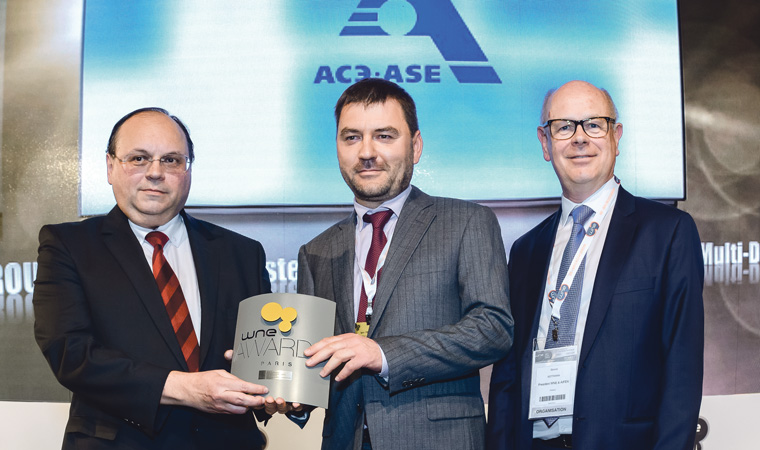
ASE-designed Multi-D-Based Project Management System won the first prize at the World Nuclear Exhibition in the Operational Excellence category. The risk of cost overruns and delays is inherent in large-scale construction projects. It can be minimized only if IT tools and business processes are properly combined and supplement each other. ASE Group has developed a special project management system based on the Multi-D technology that offers a more flexible grip on time, budget and quality parameters in capital construction projects. The idea to develop the system is rooted in ASE’s positive experience in design and construction project management and the use of software solutions developed by Dassault Systemes, particularly its 3D EXPERIENCE platform. ASE proved that a careful choice of tools could help promptly deliver projects, while sticking to the budget. Such was the case with Rostov NPP (Units 3 and 4) and Yuzhnouralskaya Thermal Power Station (Units 1 and 2). Right now, this technology is multiplied to be used at all Russian-designed NPP construction projects both in Russia and abroad. Besides, Rusatom International Network (RIN) is using the system for its consulting services for large non-nuclear projects.
Rusatom International Network in association with Business France, a government trade and investment agency, organized a seminar on prospects of civil nuclear cooperation between Russia and France.
The seminar was dedicated to joint projects of Russian and French nuclear companies in maintenance, modernization and service life extension of reactor units.
In addition to France, Russia’s other partners in Europe were discussed on the margins of the seminar. Nikolai Drozdov told the media that Rosatom did not see Great Britain’s withdrawal from the EU as a threat to the partnership between two countries. “We believe that this is no one’s business but their own. Rosatom will fulfill all of its commitments regardless of changes that might happen in the political environment,” he said. “It is hard to measure results for now, but we think this will not have any effect on us.” Rosatom’s nuclear construction projects in the European Union include Hanhikivi in Finland and Paks in Hungary. The Russian state-run nuclear corporation also provides maintenance services and supplies nuclear fuel for several nuclear stations across Europe. Besides, Rosatom maintains interest in the UK national nuclear program, according to the top management.