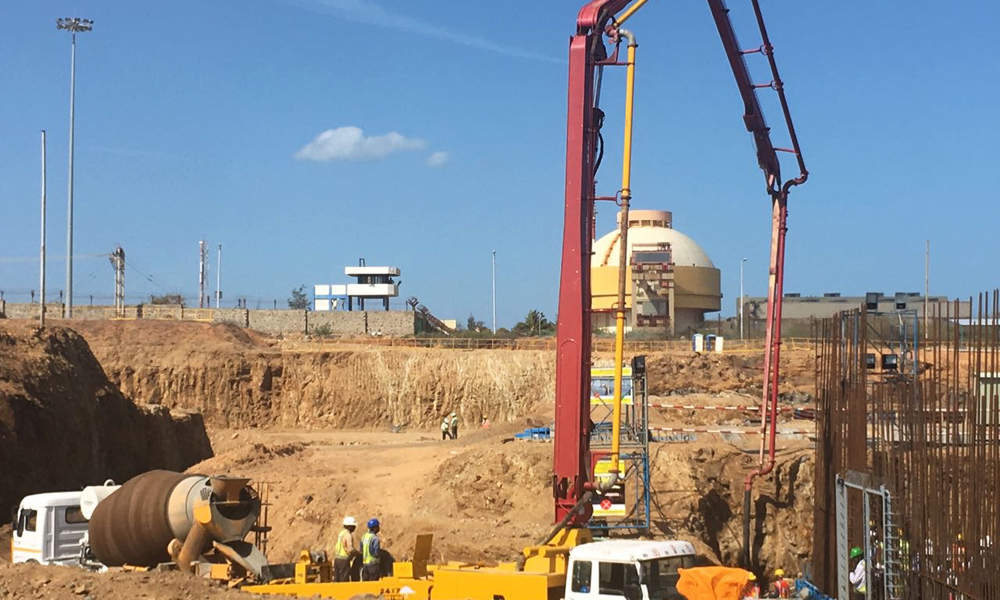
Kudankulam II comprises Units 3 and 4. On 29 June 2017, the first concrete was poured to form the foundation slab of Kudankulam Unit 3, marking the beginning of construction on the site of the nuclear power plant. “We intend to continue sharing our best practices with India and thus improve the country’s energy security,” Valery Limarenko, CEO of ASE Engineering, commented on the event. “The construction of Kudankulam with Russia’s involvement is a flagship project. In late 2016 and early 2017, Rosatom completed the handover of Unit 1 to the customer; Unit 2 was transferred to the Indian party for warranty operation. A special ceremony was organized to celebrate the two events and dedication of the power units to the people of India. And today we are beginning the construction of Units 3 and 4,” Mr. Limarenko said.
“This moment – pouring of the first concrete – marks the starting point of the construction period set out in the contract. It signals the beginning of full-scale construction, installation of heating and electrical equipment, and equipment deliveries from Russia”, said Andrei Lebedev, ASE Vice President for South Asia.
On 19 June 2017, India’s Atomic Energy Regulatory Board (AERB) issued a permit for Nuclear Power Corporation of India Limited (NPCIL) to pour the first concrete on the site of Kudankulam Units 3 and 4. Civil nuclear energy is a key area of cooperation between Russia and India. The joint document entitled Strategic View of Promoting Russian-Indian Civil Nuclear Cooperation provides for construction of at least 12 Russian-designed power units in India by 2020.
Alexei Pimenov, President of Rosatom South Asia:
“Kudankulam is one of the safest nuclear power plants in the world, with all post-Fukushima safety guidelines followed and safety systems working perfectly. Furthermore, a detailed design analysis of Units 1 and 2 let us conclude that they would withstand a Fukushima-like disaster. Their active and passive safety systems ensure an unparalleled safety level and allow for prevention of any anticipated problems in operation. These systems include a double containment, which protects the reactor internals and neutralizes external impacts, a passive heat removal system, a core catcher and a closed water intake system. The facility is also well protected from natural and man-made disasters, including earthquakes, tsunamis, tornadoes and even plane crashes. We also give much focus to environmental safety. For example, intake water from the sea passes through a ‘bucket’, a special reservoir that returns fish and plankton to their natural habitat. Kudankulam’s tariffs on power generation are the most competitive in India and the entire region. Established by the Indian government back in 2010–2011, they have remained flat and not grown a bit since then. Power generated by Kudankulam costs only 4.10 Indian rupees per unit.”
Last month, ASE Group and NPCIL signed a general framework agreement on the construction of Kudankulam III in the Indian state of Tamil Nadu. The parties also signed an intergovernmental credit protocol. According to it, Russia will provide a loan to finance equipment deliveries and preparation of construction documents. The framework agreement provides for the construction of Units 5 and 6 based on the Russian design. These documents are necessary to kick off the construction of Kudankulam III as they define mutual obligations, costs and other material terms and conditions of the project.
About Kudankulam NPP
The Kudankulam Nuclear Power Plant is under construction in the Indian state of Tamil Nadu. Designed by AtomEnergoProekt, the facility consists of VVER-1000-based power units, which are fully compliant with relevant Russian and IAEA regulations and certified to the European Utility Requirements (EUR). The general contractor of the project is AtomStroyExport (ASE) that is responsible for feasibility analysis, equipment supplies and technical assistance. AtomEnergoProekt acts as the Project’s general designer. India is represented in the project by Nuclear Power Corporation of India Limited (NPCIL).