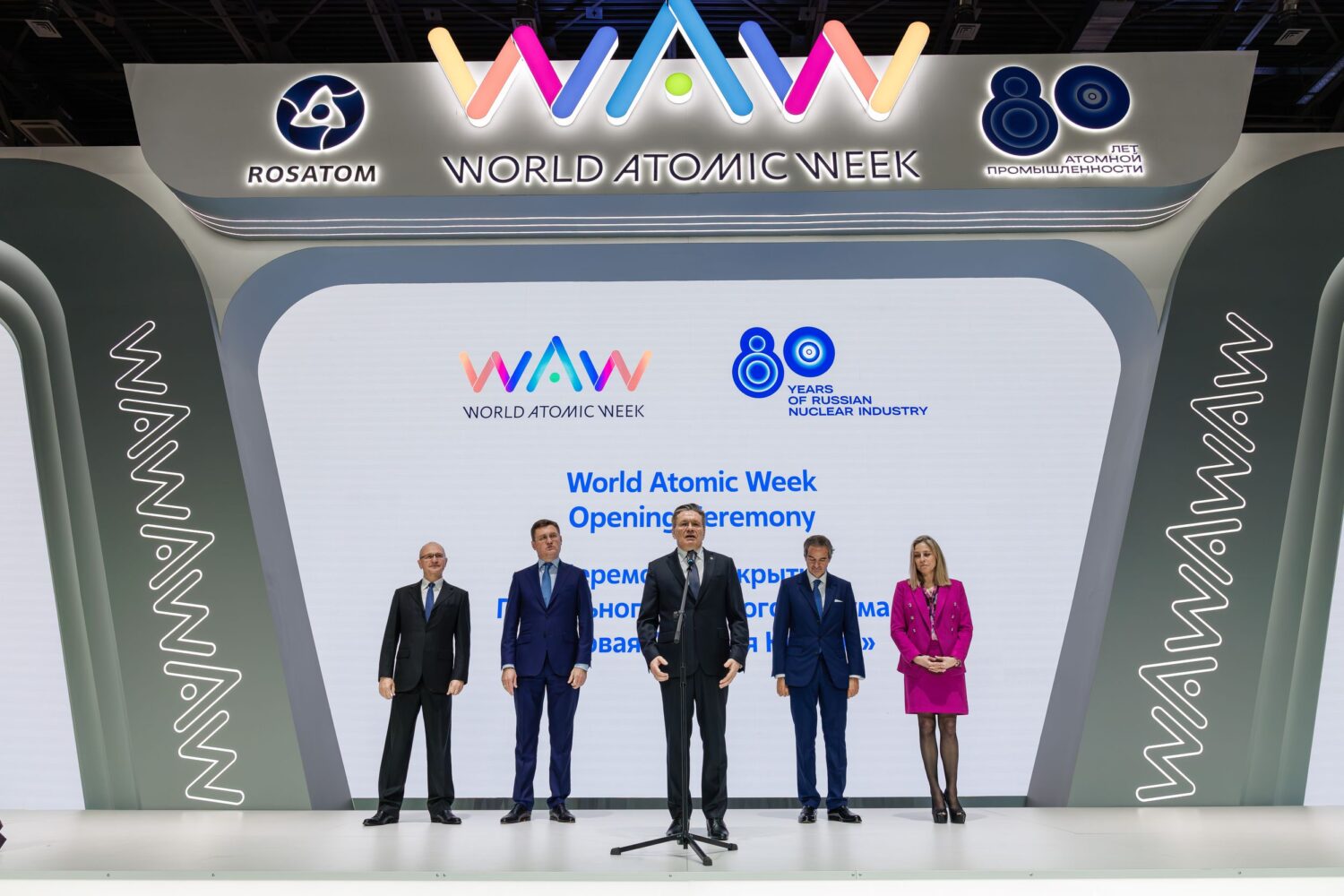
The Indonesian delegation took an active part in the World Atomic Week (WAW) international forum held in Moscow at the end of September. For more details on the forum, see the main news section of this issue. Indonesian representatives discussed with other forum participants the prospects for both large and small nuclear power plants, capabilities of nuclear medicine, production of medical isotopes, and other topics.
Small modular reactors, including their floating versions, were among the most widely discussed topics at the World Atomic Week. Two international roundtables on this technology brought together government officials and business leaders from major Asia-Pacific (Thailand, Indonesia, Myanmar, the Philippines) and African (Ghana and South Africa) countries.
The world’s only floating power unit (FPU), Akademik Lomonosov, has been successfully operating for five years in the Russian city of Pevek. Anton Yaremchuk, Deputy Governor of the Chukotka Autonomous Okrug, spoke about how the city’s life had transformed during that time, with reliable energy supply ensured, urban infrastructure modernized, and visitors from around the world coming to the city.
Floating power units that can reliably generate green electricity are an ideal solution for countries taking their first steps into nuclear power, said Andrey Nikipelov, Rosatom Deputy Director General for Engineering and Industrial Solutions. “Floating nuclear power plants are extremely convenient. They are scalable—you get exactly as much energy as you need. They are mobile—you can deploy them wherever and whenever the customer requires. We deliver ready-made power, taking on all the complex tasks related to its generation,” Nikipelov said.
Floating nuclear units can meet demand across a wide range of sectors. It is no surprise that many countries, including Indonesia, plan to deploy such technologies.
Pornperm Tongsri , Chair of Thailand’s Senate Standing Committee on Energy, stressed that even if existing capacity met the current industrial needs, tomorrow’s demands—such as those from data centers and artificial intelligence—would require considerably more energy. Small modular reactors could help address these future challenges.
IAEA Deputy Director General Mikhail Chudakov reported that the agency was working to adapt IAEA and International Maritime Organization (IMO) standards for the large-scale deployment of floating nuclear power plants, recognizing their potential and anticipating strong demand in the medium term.
Signed at WAW
Rosatom Energy Projects (part of Rosatom Atomic Energy Corporation) and Indonesia’s PLN Nusantara Power signed a memorandum of understanding to cooperate in conducting a preliminary feasibility study for the construction of Russian-designed nuclear power plants in the Republic of Indonesia. The memorandum outlines next steps in expanding Russian-Indonesian cooperation to evaluate options for integrating nuclear power into Indonesia’s energy mix.
Nuclear power for ASEAN nations
A dedicated WAW session focused on advanced nuclear energy solutions for ASEAN countries—these are nations with rapidly growing economies and populations that are increasingly interested in civil nuclear solutions. While none of the ASEAN member states currently operate or are building a nuclear power plant, several have a long track record of nuclear technology development, including operating research reactors. WAW participants discussed the steps needed to launch national nuclear programs and how approaches to adopting nuclear technologies in ASEAN countries might differ from global practices.
Nuclear medicine for everyone
The panel session titled “A Journey the Length of a Half-Life” was dedicated to the current trends in nuclear medicine and the importance of international cooperation in this field.
Awaludin Rohadi, Professor of Nuclear Chemistry and Scientific Lead of the Radiopharmaceuticals Program at Indonesia’s research agency BRIN, noted that Indonesia operated three research reactors. They produce critical medical isotopes such as iodine-131 and samarium-153. Several other high-demand isotopes, including terbium-161, are currently in the R&D phase.
Sergey Surov, Director for Radiopharmaceutical Products and Nuclear Medicine at Rosatom Science, highlighted growing global interest in terbium-161-containing radiopharmaceuticals. A number of companies are already conducting preclinical studies of these drugs, and some have moved to the clinical phase. “Large-scale cooperation is essential, and the first step could be collaboration on the production of terbium-161 and its derivatives. We propose setting up an international platform—a multinational expert group—for intensifying terbium research in nuclear medicine, which would combine technologies for nuclide production, purification methods, development of advanced radiopharmaceuticals, and clinical transfers of results,” Surov said.

The capabilities of research reactors were also explored at a roundtable titled “Symphony of the Neutron Flux—The Score of Progress: How a Research Reactor ‘Sounds’ in Every Sphere of Life.” Dr. Marlina Marlina , Head of Radioisotope Technologies Group and Deputy Director of BRIN’s Research Center for Radioisotope, Radiopharmaceutical, and Biodosimetry Technology, shared her experience in applying research reactor products in nuclear medicine. She announced plans to expand the network of cancer diagnostics and treatment centers with the support of Russian technologies. It is planned that residents across all the country’s islands will have access to PET scanning by 2027.
Women in STEM
Supporting women in industry was another important topic discussed at WAW with the participation of the Indonesian delegation. An international review of best practices from 16 countries was presented on the sidelines of the forum. The review was prepared by member countries of the International Council for the Support and Development of Women in Technology and Industry established on Rosatom’s initiative.
“This document will serve as a handbook for replicating the experience and best competencies of women from 16 countries. Importantly, work on this document will continue on an annual basis, with new chapters added as more countries join,” said Tatyana Terentyeva, Deputy Director General for HR at Rosatom.
This year’s Chair of the International Council is Geni Rina Sunaryo, Head of Women in Nuclear at the Indonesian Nuclear Society (HIMNI). She outlined this year’s key activities in her speech. “Throughout the year, our Council’s Girls in STEM working group has held seven online events for female students at technical universities worldwide with support from the Women’s Community of Rosatom. In November, we will, together with the Women’s Community of Rosatom, co-host the first Russia–Indonesia Forum of Women in High-Tech Industries. The focus will be on Indonesia’s high-tech development plans amid the global technological transition, including the deployment of nuclear energy technologies to ensure energy security and industrial growth,” said Geni Rina Sunaryo.
Ideas for the future
The final of the Global HackAtom international student competition sponsored by Rosatom was held as part of the World Atomic Week. The event brought together over 50 national-stage winners from ten countries. Finalists had 24 hours to develop concepts for the use of future nuclear technologies in space. Indonesia’s Tahu Sumedang team won second place, proposing a method for monitoring astronauts’ sleep rhythms and a therapy concept incorporating radioactive isotopes. The team also received a special award for an outstanding idea and presentation.
The international jury praised the teams’ level of knowledge and noted their inspiring vision for nuclear technologies in space.
In addition to participating in the WAW business program, forum guests eagerly explored the exhibition dedicated to Russia-Indonesia cooperation, learning about Indonesia’s energy development plans as well as its rich culture and traditions.
Photo by: Floating NPP (FNPP), Strana Rosatom newspaper, Rosatom Scientific Division