Russia, a global leader in next-generation reactor technologies, has completed the manufacturing of a full set of reactors for a floating power unit, and passed key construction milestones for the BREST-OD-300 and MBIR fast-neutron reactors. A molten salt reactor (MSR) project has moved a step closer to implementation. Here are the third-quarter updates on advanced reactor construction programs.
The MBIR reactor will be used for cutting-edge research in reactor technologies and materials science on both national and global scales. It will host an international research center, which is structured as a consortium, granting its members priority access to experiments for their national nuclear programs.
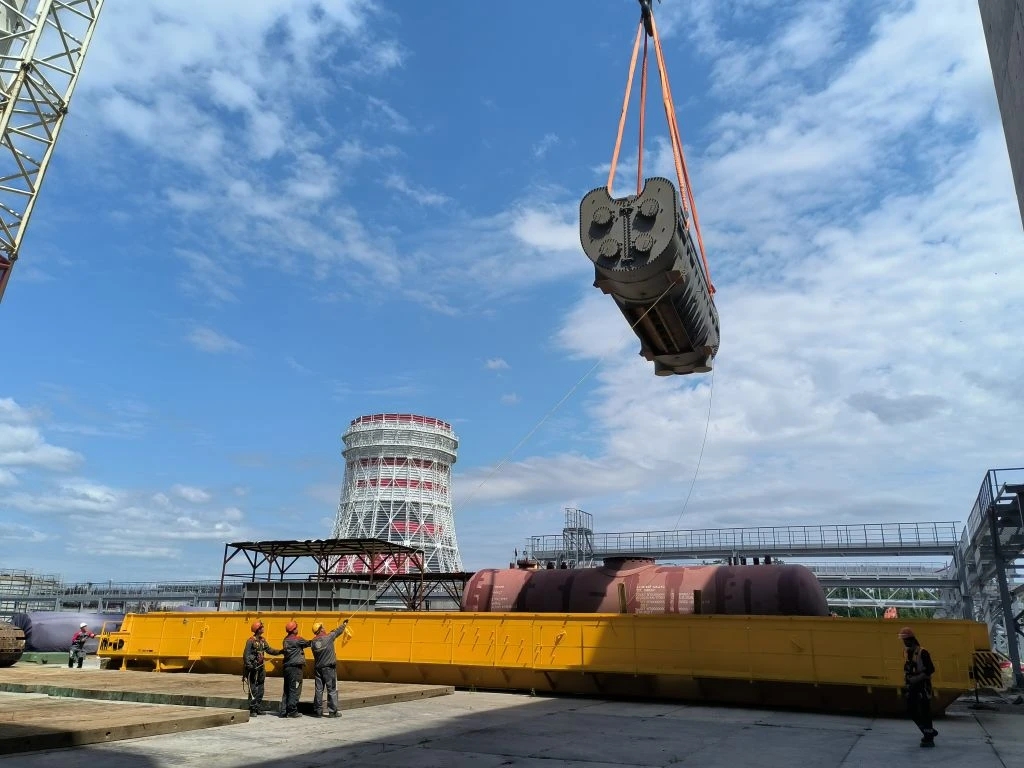
In July, a 12-tonne, 5.5-meter-tall air-cooled heat exchanger was installed for the second loop of the emergency heat removal system (EHRS). It will facilitate heat transfer from the EHRS sodium circuit to the ultimate heat sink (the ambient air). A 70-tonne power transformer was installed in its design position at the power evacuation substation. In the turbine building, a 16-tonne transition duct was mounted onto the upper nozzle of the condenser, connecting the exhaust section of the turbine casing to the condenser itself. Furthermore, the installation of key overhead crane components, including bridge girders and a hoist trolley, has been completed. A 750-tonne crawler crane was deployed to carry out these highly complex lifting operations.
BREST-OD-300
The BREST-OD-300 reactor, currently under construction at the site of the Pilot Demonstration Energy Complex (abbreviated ODEK in Russian), is a core component of Rosatom’s strategic Proryv (Breakthrough) Project. The operation of the reactor, alongside ODEK’s fuel reprocessing and fabrication/refabrication modules, is designed to demonstrate the feasibility of closing the nuclear fuel cycle using a fast neutron reactor and multi-recycled nuclear fuel.
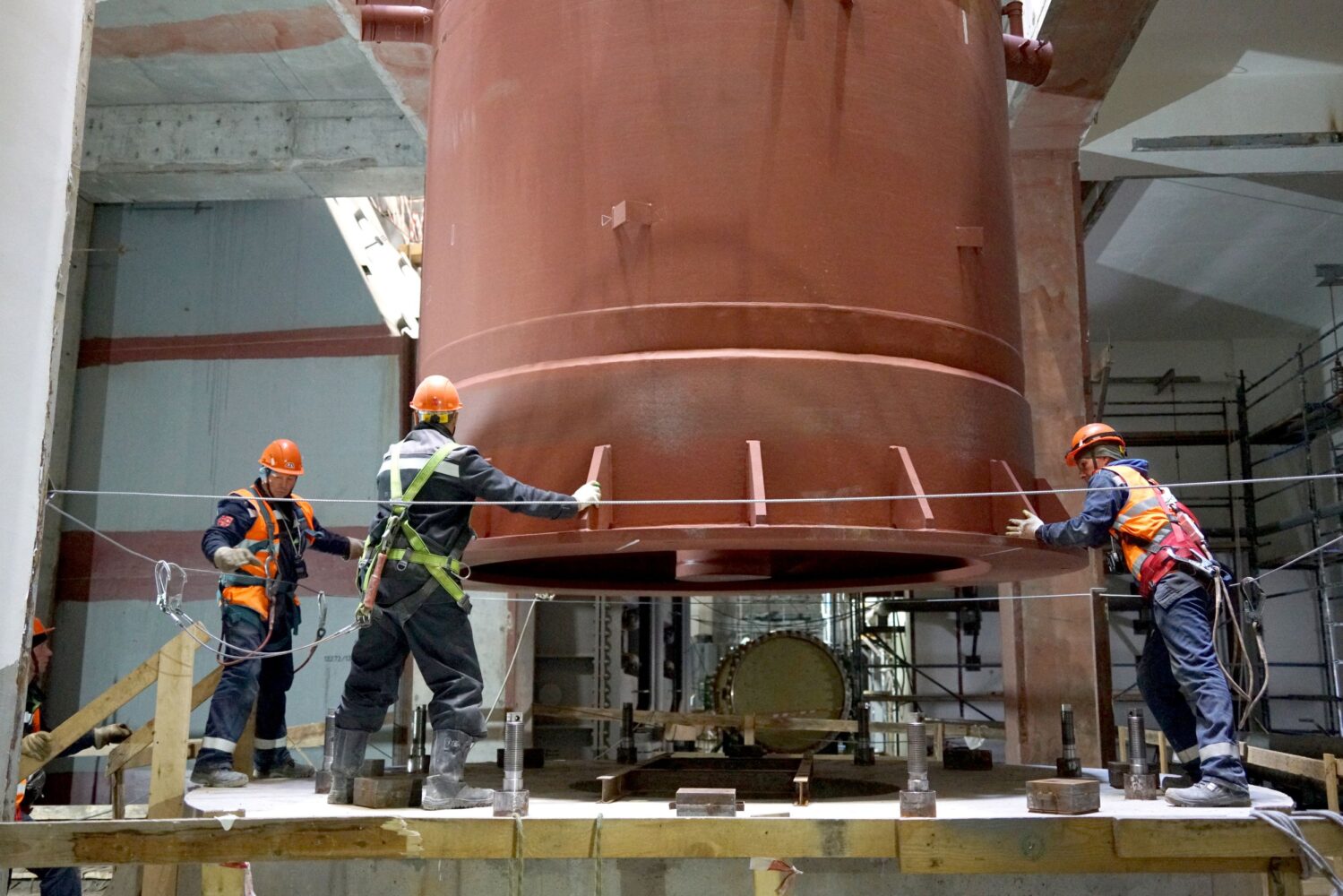
In September, the first phase of concrete pouring for the inner cavity of the reactor vessel was completed at the site. The use of concrete is a distinctive feature of the BREST-OD-300 design. The reactor consists of steel cavities that will house the core and primary circuit equipment. The space between these cavities is filled with concrete, which serves as a load-bearing structural element, as well as thermal and radiation shielding. This design ensures the safe and reliable operation of the world’s first lead-cooled fast reactor.
Meanwhile, reactor components are being installed. For instance, the installation of the piping system connecting the central and four peripheral cavities of the reactor vessel has been completed, effectively closing the primary circuit loop.
In October, two moisture separator reheaters, each 16 meters tall and weighing 95 tonnes, were installed in their design positions on the turbine island. The turbine foundation is scheduled for completion by the end of 2026, to be followed by the installation of the power unit’s turbine.
Molten salt reactor
The program to build a molten salt reactor (MSR) is also progressing. Like the Proryv project, it contributes to closing the nuclear fuel cycle. The MSR will be used for the industrial-scale transmutation (or “burning”) of minor actinides — highly radioactive, long-lived isotopes. Without these isotopes, radioactive waste becomes significantly less hazardous, making storage requirements drastically simpler and storage periods significantly shorter.
A new laboratory dedicated to the MSR is being built at the Radium Institute (part of Rosatom’s Science Division). By the end of 2026, the laboratory is scheduled to be ready for conducting the first research activities.
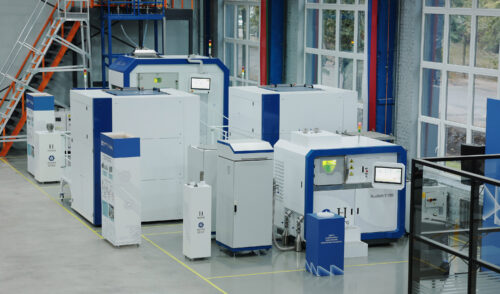
The laboratory will test technologies for handling and reprocessing spent nuclear fuel from the MSR. The first testing phase will involve synthesizing a model fuel composition based on lithium and beryllium fluorides, which will also include simulants of fission products and plutonium. Subsequently, the technologies will be tested on a mock-up.
“The main stage of the technological process is the mixing of two molten phases under active hydrodynamic conditions, the fuel salt and lithium bismuthide. In this process, lithium transfers into the fuel salt, while neutron poisons extracted from the salt transfer into bismuth. Our equipment has no counterparts worldwide,” commented Ilya Skrigan, Head of the Laboratory for Radioactive Waste Solidification Technology and Processes at the Radium Institute.
RITM-200
In September, ZiO-Podolsk (part of Rosatom’s Mechanical Engineering Division) manufactured the second RITM-200S reactor for the FPU-106 floating power unit. The first one was completed in May of this year. That means the complete two-reactor set is now ready for installation.
“This is an important step in the development of small-scale nuclear generation worldwide. Our plant has set a record this year: four RITM-family reactors have been manufactured in less than a year, and five more are in production,” said Anton Lebedev, CEO of ZiO-Podolsk.
The FPU-106 will become the world’s first example of powering a large industrial facility using floating nuclear power units. Russia is the only country with such operational experience: since 2020, the Akademik Lomonosov FPU has been operating in the northern region of Chukotka, having generated nearly 1.4 billion kWh of electricity.
To date, a total of 16 RITM reactors have been manufactured, eight of which are currently operating on the Arktika, Sibir, Ural, and Yakutia nuclear icebreakers.
Photo by: SSC RIAR JSC; SCC JSC; ZiO-Podolsk JSC