During the year Rosatom has sped up its pace a great deal, as said the Corporation’s General Director Sergey Kiriyenko at the Atomex-2013 Forum recently held in Moscow. “Our scope of work is growing. Each started unit suggests 1.5-2 times bigger stock of orders”, – he said. One of the main Russian construction victories for 2013 is the beginning of preparation works for the Kursk NPP-2, where the first plant with VVER-TOI unit will be built. Besides, the third unit of the Rostov NPP is planned to be launched in 2014, a year earlier that it was planned. “We now start getting what we’ve wanted – serial launches of NPPs” – the head of Rosatom summed up.
First with VVER-TOI
The Kursk NPP this year has received its site – Makarovka, near the town of Kurchatov, Kursk region – and an official state status. In the end of November the governor of the region Alexander Mikhailov signed a provision concerning the construction of units 3 and 4 of the plant. The authorities understand very well that the new plant is necessary, so do local inhabitants – the construction was supported at the recent public hearing. “The VVER-TOI project planned to be implemented at the Kursk NPP-2 – said Vladimir Potsiapun, the Chairman of Subcommittee for Legislative Provision of Atomic Energy of the State Duma Committee for Energy, – represents one of the most advanced technologies, guaranteeing safe work of nuclear industry objects. Its implementation on the Kursk ground will show the vector of development of domestic nuclear industry towards more safety, efficiency and competitiveness of Russian nuclear power”.
This year they were getting ready for building another station with VVER-TOI reactor – Smolensk. In January 2013 the project implementation plan was enacted, the implementation itself started in April. “We are to prepare the site, make the project, attach it to the construction ground, start forming construction base, determine contractor organizations, constructors, conduct tenders, – says Evgeny Romanov, General Director of Rosenergoatom, Russian NPP operator. – By the moment we are ready to start the construction our preparedness should be high, so we can pass to construction immediately”.
A year left before start up
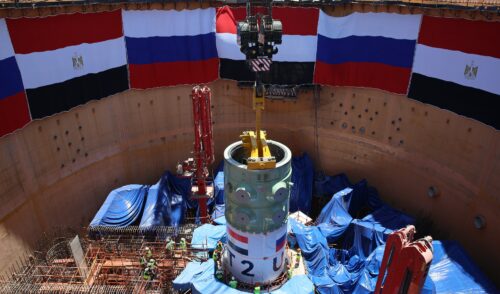
The construction of unit 3 of the Rostov NPP is going on ahead of schedule. “According to the schedule the start-up was planned for 2015. Seeing how the work is going on we decided to change it for 2014, – said the head of Rosatom, having visited the site at the end of November. – In December 2014 unit 3 will be launched. The work has become tense since we changed the deadline, however, I don’t have any doubts. The work on site is organized very well and I’m quite sure that it will be done on time” – said Mr. Kiriyenko. He added that, taking into consideration this shift, the start-up of unit 4 might also be earlirized.
There is one more unit planned to be launched in December 2014 – at the Novovoronezh NPP-2. The scope of installation and construction works done on site, summarizing the results of 11 months of 2013, was RUB 12,7 billion, which is 103% of planned.
Beat the target
While the new units are under construction, the operating ones continue to supply energy to the country. The Russian NPP run in 2013, according to preliminary data, will be 171,8-172 kW/h of energy, said the head of Rosenergoatom, Evgeny Romanov. “Even the Rosatom’s aggressive task of producing electric energy is to be fulfilled”, – he said. Mr. Romanov noted that energy production by Russian NPPs in 2013 will be somewhat smaller than the previous year (177,3 billion kW/h), since several power units of high-power pressure-tube reactors this year were stopped for maintenance. According to Romanov, the Rosatom’s task for producing 171,6 billion kW/h in 2013 is on its way to be fulfilled. “It is still too early to speak about the final number, however our schedule that we have for today is overdone by 180 million kW/h”, – he said.
Expanding the market
There were many important events having taken place at the Rosatom’s foreign construction sites as well. In September the Bushehr NPP was delivered to the client in Iran, this NPP having put a strong basis to Russian-Iranian relations in the nuclear sphere. Russia and Iran are discussing construction of new nuclear station in Bushehr which might begin as early as in 2014, said Ali Akbar Salehi, the head of Atomic Energy Organization and Vice-President of Iran. According to him, Russia is ready to continue the two countries’ nuclear partnership.
In September the first concrete was poured at unit 4 at the Tianwan NPP in China. There are already negotiations concerning potential construction of units 5-8. Besides, as said Valery Limarenko, they also discuss a project of building fast breeder reactor plant and an option of floating NPP with small power reactors.
In autumn the corner stone was laid at the Ruppur site in Bangladesh. The station to be built on the river Gang shore will be, according to Sergey Kiriyenko, the most up-to-date and safe in the world. Besides, Russian industrial enterprises will be provided with orders for years in advance.
From Europe to Africa
2013 was the year of many Russian victories in important NPP construction tenders abroad. Such as Finland, for instance. Fennovoima and Rusatom Overseas, subsidiary of the Russian Rosatom, on 21st December, 2013, signed the plant supply contract for the Hanhikivi 1 nuclear power plant that is to be constructed in Pyhäjoki, Finland. According to the schedule agreed with Rusatom Overseas, the power plant will produce electricity in 2024. In November, Fennovoima owners made conditional decisions on continuation in the project. Each shareholder who made a positive decision then will give confirmation for the negotiation result that has now been achieved and thus will by the end of February 2014 give confirmation for participating in the project. This means that the final investment decision about constructing the nuclear power plant in Pyhäjoki is made in the end of February. At the same time Rosatom will take over a 34 per cent share of Fennovoima.
Fennovoima is planning to apply for construction licensing in summer 2015. The site works will be going on at the same time in order to begin the construction as soon as the approval is granted.
Rosatom has also won the tender for building NPP in Jordan. The Russian offer, made as an EPC contract, turned out to be the best in terms of safety and design. It suggests building two power units with the capacity of more than 2 GW. Besides Rosatom the following companies took part in the tender: Canadian AEСL, Japanese-French Areva and Mitsubishi. The plant will built at a distance of 25 km from the town of Aqaba, on the Red Sea coast.
Rosatom also has good perspectives in the RSA, offering whole technological chain in construction and operation of NPP and is ready to call the RSA companies to the third countries’ markets. Rosatom also believes it possible to build a nuclear fuel plant if the atomic power in the country keeps developing. The Minister of Energy Benedict Martins said the RSA planning to complete all domestic procedures confirming the intergovernmental agreement with Russia in cooperation in the sphere of peaceful atom by February 15, 2014. He said, the agreement was already initialed and was being accorded with the RSA Ministry of Energy and Ministry of Finance.
Today’s right stating documents for power units’ construction abroad are:
The Akkuyu NPP in Turkey – 4 power units
The Tianwan NPP in China – 2 power units
The Belarus NPP in Ostrovets (Belarus) – 2 power units
The Armianskaya NPP (Armenia) – 1 power unit
The Khmelnitskaya NPP in Ukraine – 2 power units
The Ninh Thuan NPP in Vietnam – 2 power units
The Ruppur NPP in Bangladesh – 2 power units
The Kudankulam NPP in India – 4 power units
Atomenergomash
One of the key achievements of the company of the year is the integration of Atommash of Volgodonsk. Back in 2012 they started building the first reactor in 26 years, meant for the Baltic NPP, the work over work parts of the first NPP in Belarus is coming to its end – reactors for the plant will also be produced by Atommash. The reconstruction of steam-generators production is in progress: the enterprise is to present 8 and in future 12 steam generators a year. Today Atommash is producing equipment for 5 NPPs being built in Russia and abroad: Novovoronezh, Baltic, Rostov, Belarus, Leningrad. Those are reactors, steam generators, core melt traps, MCP vessels and other key equipment. By 2015 Atommash should set up production of all main equipment for nuclear stations, including VVER system and turbine island (in cooperation with French Alstom), this will allow Atomenergomash to become one of 5 world’s companies/alliances able to supply both NPP islands.
Ukrainian enterprise “Energomashspetsstal” shows excellent results as well. In 3 years Rosatom invested there about $100 million and now EMSS is the only enterprise in the world, certified for work part supplies for all major NPP equipment producers (Rosatom, Toshiba, GE, Areva, Alstom, Siemens etc). The enterprise also took part in such a wide-scale project as the Sayano–Shushenskaya Dam, Boguchany Dam reconstruction, construction of Dniester HES, developing new kinds of products for the wide range of industries – aircraft engineering, transport machine-building, shipbuilding, metallurgy. Today EMSS is a supplier of the world brands like Boeing, Airbus, Rolls-Royce, ArcelorMittal etc.
This year Atomenergomash has won the tender and started complex production of RITM-200 reactors for the first nuclear icebreaker of the new generation – “Arctica”. Equipment for reactor installment will be produced by ZiO-Podolsk, based on the project of OKBM Afrikantov.
Not a long time ago Atomenergomash entered the heat market of Ukraine, having won the tender for supplying boiler equipment for Starobeshevskaya TPP (Donbassenergo). Before that an actual boiler monopoly belonged to the “Krasny Kotelshik” plant. Due to the development of the Volgodonsk site and ZiO-Podolsk enterprise Atomenergomash has also become a reliable supplier of oil and gas equipment for major Russian companies: Lukoil, Rosneft, Gazprom.
Technological victory
One of the main technological victories of the State Corporation this year has been the beginning of construction of a new-generation nuclear icebreaker by the Baltic Shipyard. The universal atomic turboelectric project 22220 icebreaker is to become the biggest and mightiest in the world.
The icebreaker will be equipped with RITM-200 reactor energetic installment with the capacity of 175 MW, designed by OKBM Afrikantov, one of the leading atomic engineering organizations. “The reactor installment will be ready by January 2016, assembly will last till December. Reactor loading will take place in the first quarter of 2017, physical start – in several months after that”, – Mustafa Kashka, First Deputy Director, shares his plans.
Innovations are in focus
In 2013 two innovative projects in fast breeder reactors have been implemented in Dimitrovgrad – preparation to construction of experimental-industrial power unit with SVBR reactor and MBIR – multipurpose research reactor. There had been made a decision to establish an international research center based on the MBIR project and in 2013 the relevant contract was signed with the US Department of Energy and CEA of France (Commissariat à l’Energie Atomique)
In 2013 we successfully presented our “Condor” – in Russian it is a contraction from “road control” (control dorog) – an asphalt quality controlling device. The first sample was given as a present to the Moscow city executive board, since Moscow today is doing a lot of road construction. We expect the device to be a commercial success and in demand in all country’s regions, since its features leave behind foreign analogs.
Olympic flame
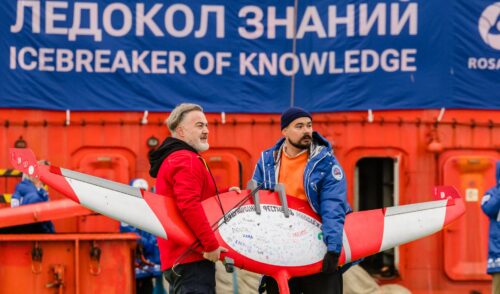
Certainly the most beautiful social project of Rosatom is the support of the Olympic torch relay for Sochi-2014, the longest one in the whole history of the Olympics. In October the torch for the first time visited the North Pole, having covered more than 5 000 km in 15 days from Murmansk to the North Pole and back. The “North Pole” ecological special project, supported by its technical partner, Rosatom, made the route truly unique. Rosatom provided the torch delivery, members’ safe debarkation to ice, lighting the torch, food and medical attendance.