
News
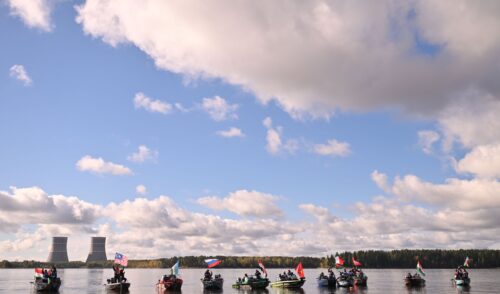
Cooperation. Rosatom hosted the 4th International Fishing Tournament, which this year took place on Lake Udomlya near the Kalinin Nuclear Power Plant in Russia. The event brought together 22 anglers from 11 countries. The Malaysian team caught the largest fish, a 1.7-kilogram zander. The Hungarian team was awarded the Will-to-Win prize, while Russian anglers took first place in the Largest Catch category by landing the widest variety of fish species native to the lake. During the official weigh-in, the catch was checked for radiation and found to be completely safe. The anglers also visited the Kalinin NPP. “The International Fishing Tournament has become one of Rosatom’s flagship outreach initiatives, demonstrating the environmental sustainability of nuclear power,” noted Alexandra Yustus, Deputy Director General for Communications at Rosatom International Network. The tournament is regularly held in water bodies adjacent to nuclear power plants. In 2025, it was hosted outside Russia for the first time, taking place near the Akkuyu NPP construction site in Türkiye.
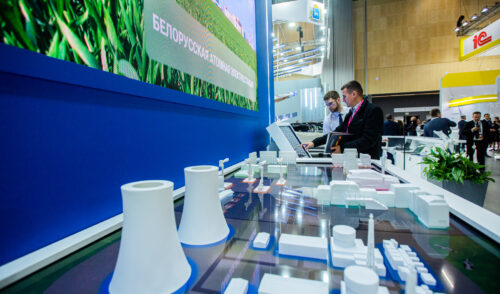
Technologies. Rosatom showcased its solutions for power engineering, industry, and transport at the Innoprom.Belarus exhibition. The corporation’s booth featured a scale model of the Belarusian NPP, lithium-ion batteries, digital simulators, composite materials, and other innovations. Heads of government from Russia, Belarus, Kazakhstan, Kyrgyzstan, and Uzbekistan also reviewed the key milestones of Russia-Belarus cooperation in nuclear energy and related high-tech sectors. A prime example of successful industrial integration is the first joint Russian-Belarusian RusMelt 150M metal 3D printer, with more than half of its components manufactured in the two countries. “Belarus is our long-standing and close partner. Together, we are developing and advancing cutting-edge technologies across key economic sectors. The Belarusian NPP is a strategic project that has laid the foundation for our collaboration in numerous non-energy domains,” noted Stanislav Levitsky, Director of Rosatom’s Country Office in Belarus. This cooperation is being advanced under a comprehensive bilateral program running through 2030.
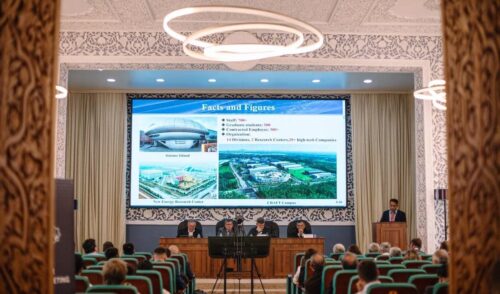
R&D. Tashkent hosted the third meeting of the Advisory Board of the International Research Centre based on the Multipurpose Fast Neutron Research Reactor MBIR (IRC MBIR). The meeting brought together representatives from research institutions, industrial companies, universities, and international organizations to discuss the development of research infrastructure, advanced nuclear energy technologies, and personnel training. “Nuclear science and nuclear power have always served as catalysts for progress across a multitude of other disciplines, and the broad geographic representation at today’s meeting — spanning Korea, India, the CIS, Brazil, and African countries — is direct proof of this,” said Stepan Kalmykov, Chairman of the MBIR Advisory Board and Vice President of the Russian Academy of Sciences. The MBIR is a 150 MW multipurpose fast-neutron research reactor currently under construction in Dimitrovgrad, Russia. It is designed to test materials, equipment, and next-generation nuclear technologies, as well as to produce radioisotopes. The International Research Center, which will operate the reactor, is structured as a consortium, granting its members priority access to experimental capacities for their national nuclear programs. The consortium remains open to new partners.