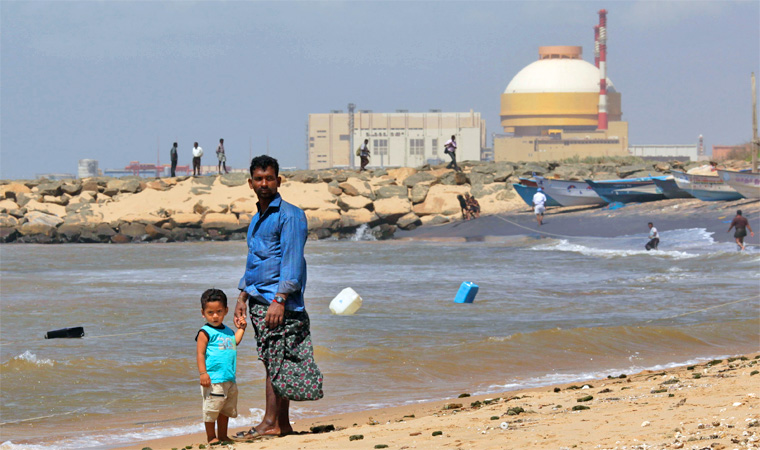
Today the first power unit of the Indian Kudankulam NPP, constructed by Rosatom, is being prepared for launching. The feelings about the event in the region, where the NPP is situated, are quite mixed. However there is no doubt that the two new power units will help the region to solve the problem of lack of electrical energy and push to business and industry development. Rosatom Director General told in his interview to RIA Novosti about the prospective of the Russian-Indian nuclear power cooperation. Here are some extracts:
– Russian-Indian cooperation in the “atom for peace” today is one of the most fruitful. How do you see its future?
– It’s true that we have achieved some very good results together with our Indian partners. Today we have the Kudankulam NPP already built, totally corresponding to all norms and safety requirements, introduced by IAEA after the Japanese earthquake. To a certain extent this is the result of the initial intention of our Indian clients to build the plant with all possible safety systems existing and transmitting all our offers concerning modern solutions. The unit has double localizing and protecting covers, that would resist even a plane crash. The hydrogen recombiners won’t allow any explosion from inside – that’s what happened at Fukushima. The passive rejection of heat system will cool down the reactor in case the electricity gets cut down while the corium trap won’t allow radioactivity to go outside the power unit even in case of the unit destruction, which is possible only hypothetically.
These systems along with some other provide unprecedented design level of the NPP safety. Besides, upon the request of the Indian side, the station has a water desalinization system, that would fully satisfy the NPP requirements. Of course, this all influenced the cost of the project, but today we see that the expenses are fully justified. This inspires respect, along with the fact that the Nuclear Power Corporation of India fully used the potential of local construction and installation organizations while building the NPP. Even if this resulted in some off-schedule deviations, everyone understood, that things like that give more competence and experience to Indian workers in building NPP based on Russian technologies. Thus the other units will be built faster.
– Did the station go through the stress-test?
– It did. Not regarding the fact that the safety systems in the project initially fully corresponded the requirements of IAEA and control organizations of both Russia and India. Remembering the Japanese catastrophe, we together with our Indian colleagues conducted some additional analysis. The test showed very high resistance of the plant. Should even all the systems of water and energy supply go off for a long period of time, the station will be able to stop the fission reaction independently, derive residual heat and provide all necessary safety.
Thus we can honestly say that if the station like this was at the Fukushima NPP and suffered all the extremities, it would have been able to resist. This is what is now called “meeting post-fukushima requirements” in safety. Besides, using the results of the stress-tests we developed some recommendations to the Indian operator concerning additional safety provision, and all these means are taken into consideration by the Nuclear Power Corporation of India.
– The global hysteria influenced the launch date of the plant which could have been put into operation a year ago. Besides, according to the reports of the Indian government, disorders concerning the station were initiated by certain foreign non-governmental organizations with their representatives even detained by the police. What do you think about this situation?
– It goes without saying that the domestic policy is the jurisdiction of the Indian government, so I cannot really comment upon this. What we know is that there are a lot of fishermen’s villages around the city of Kanyakumari, and that somebody told the fishermen that the plant may affect their take, reduce it. Who and why would spread this kind of lie – that is another question. But people are worried, they lack true information. In Russia we annually hold fishing championships on our cooling-water ponds. Fishermen who come to us from all over Russia have no relation to nuclear industry. However the fishermen federation likes to hold its activities on our water bodies. They see that we take good care of the pond environment, and that fish there feels good and there is plenty of it.
Moreover, one can meet species that are extinct in ordinary lakes that nobody cares about. The same situation once occurred near the Tianwan NPP in China, built on Russian technologies at the Yellow Sea. Today one can see that the shrimp catch there hasn’t reduced a bit, while the demand of shrimp has grown due to the increasing number of well-paid specialists. As a matter of fact, we helped our Indian colleagues to organize a tour for fishermen from the city of Chennai, the capital of the state, to the Tianwan site, so they can see it all with their own eyes. The Indian specialists have done their own research on the subject near the Kalpakkam site and came to the same conclusion: no negative effect to water fauna.
– Now, when the two units of the Kudankulam NPP are almost ready, what comes next?
– First of all it is further construction at the site, since there are also units 3 and 4. This July in Moscow we signed a loan agreement on the second preference construction financing. Now we are ready for the project implementation. Currently the Indian side is considering the approval of the technical and commercial proposal for supply and services for the units construction, and our version of the Master Framework Agreement. I hope that in the near future we will come to agreement on this issue.
– What are the negotiations about?
– We are agreeing on the scope of additional equipment and services which the Indian side would like to include in the project for the new units construction. This is the customer’s choice, which we respect.
– And what is your opinion on the new Indian law on equipment suppliers’ liability for nuclear damage?
– We work in many countries and everywhere our concern is to fully correspond to the international legislation. New units of the Kudankulam NPP also have to meet this requirement and will also be based on the intergovernmental agreement, ratified by the Parliaments of the two countries. This is an international agreement. All over the world the liability lies with the operating organization and it is fair.