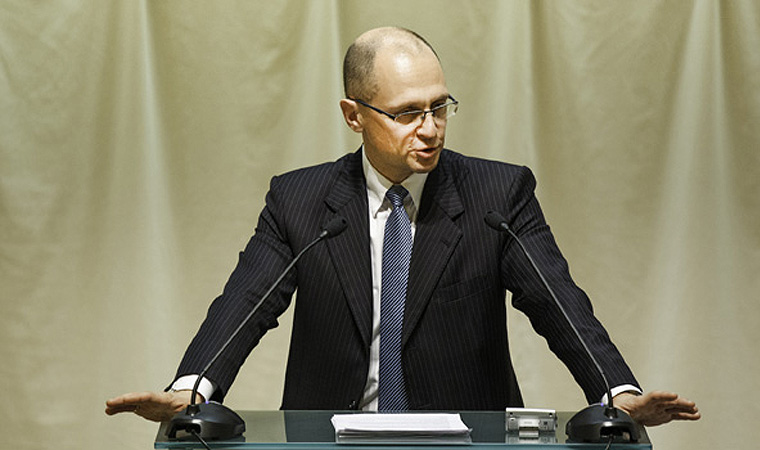
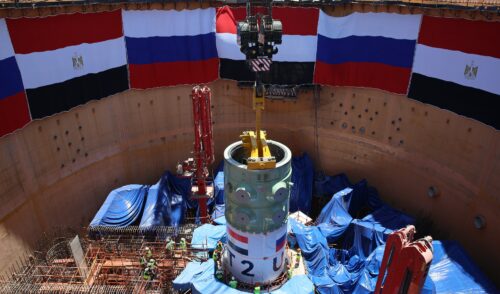
The development of nuclear power in Russia continues its progress. The pace of the State Corporation is quite good. This is fair for all kinds of Rosatom activities, starting from uranium development and finishing with NPP building both in Russia and abroad. According to Sergey Kiriyenko, the Director General of Rosatom, all the tasks of 2012 are completed. On the Kalinin NPP power unit 4 was launched. In Belarus the work on the NPP project began. In China pit concreting for power unit 3 of the Tianwan NPP (the first two blocks were also built by Rosatom) was finished. In India power unit 1 of the Kudankulam NPP (see details in the interview of Sergey Kiriyenko) was completed. In Ukraine a nuclear fuel plant for NPPs with VVER types of reactors is under construction. Let’s get a close-up on the events of the year.
Raw Material Base
In 2012 a mid-term development program was started at PIMCU (the Priargunsky Industrial Mining and Chemical Union), the main uranium asset of Russia. At the end of the year a key event occurred (we wrote about it in the previous release) – phase 1 of Mine #8 was launched, with annual production of more than 380 000 tons of ore. Starting from 2016 the mine is expected to provide the plant with up to 500 additional tons of uranium per year. Besides the enterprise is looking forward to construction of Mine #6 with expected production of up to 600 000 tons of ore starting from 2020.
Future Technologies
In 2012 Rosatom continued moving toward its strategic goal – nuclear fuel cycle closing and fast breeder reactors building. The discussion of the “Proryv” (breakthrough) project is going on. “Proryv” is meant to form the image of nuclear power of the future – commercially successful, viable and safe. The planned type of production is SNF recycling.
In 2012 the site was picked out. It is SCC (Siberian Chemical Combine), one of the biggest nuclear centers in the world. It is situated in Tomsk oblast. In February Sergey Kiriyenko said that in 2017 there would be a complex for experimental fuel production, while the nuclear power would switch to it in 2020. At the end of October another important step was made – a manufacturing facility for the dense nitride fuel was installed at the plant.
By 2020 at the SCC they will build a power complex with the Brest-300 fast-breeder reactor. According to Vadim Lemekhov, the Chief Designer, the documentation for reactor installation licensing is already being prepared and the whole work will be completed by 2014. The work over alternative SVBR project (lead-bismuth fast-neutron reactor) is going on. See details in the interview with the AKME-Engineering Director in the release №3. In 2012 R&D and project works were continued. The first reactor is planned to be built in Dimitrovgrad, Ulianovsk oblast, by 2017.
SNF and Radwaste
In 2012 in Russia a principal law concerning radioactive waste came into operation. The National Operator for management of radioactive waste is now the only organization, authorized to be a customer for projecting, construction and operation of specialized deposits. Its main task for the future years will be an SRW burial facility in Nizhnekamsk with the cost of RUB 24 billion with in-service date of 2021. The low and medium active waste burial site in Novouralsk (service date 2015) and of solidified medium active waste on PA Mayak are currently under construction.
Today Rosatom is working on the RAW initial registration. The result will be the RAW data update. The government, in its turn, ratified the RAW criteria. The cost of RAW burying was ratified as well. The Ministry of Natural Resources and Environment was appointed as controller in the sphere. In order to establish a decommissioning scheme experimental demo-centres (EDC) will be created One of them will be registered as an SCC affiliate and will work with carbon uranium reactors. There is already one EDC for the VVER-type reactors formed on Novovoronezh NPP, which later will be a special branch of the Rosenergoatom.
Generation 9
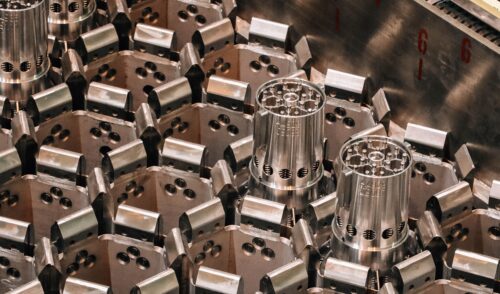
The most important event in uranium enrichment sphere is the centrifuge of the ninth generation start-up, which took place at the Electrochemical plant (part of Rosatom fuel division, TVEL). The developer of the new centrifuge is Afrikantov Design Bureau in Nizhny Novgorod. At the final stage the new model was being tested for a year and a half at the Urals Electrochemical Combine. Today the work on the tenth generation centrifuge is in progress. As said the TVEL Director General, Yury Olenin, the revolutionary new centrifuge may be put into operation in 2014-2015.
Fairway
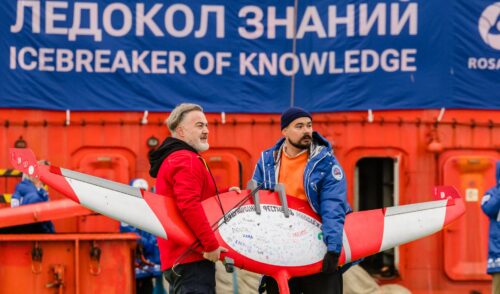
One of strategic goals of Rosatom is the development of Atomflot. Russia is the only world’s country that has atomic icebreakers. Let us remind our readers, that the key event of 2012 for Atomflot was signing a contract with the Baltiysky Zavod shipyard on building an icebreaker of a new generation. The vessel is planned to be floated out on December 30, 2017. The project cost is RUB 37 billion. The capacity of the icebreaker reactor will be 60 MW. The supposed name of the vessel is Arctica. The difference between the previous generation icebreakers and the new one is a special ballast pumping system permitting the vessel to change its draft. Thus not only will it sail via Northern Sea Route, but over Siberian rivers as well. Two more atomic icebreakers are planned to be constructed at the Baltiysky Zavod shipyard in the near future.
Foreign Expansion
In 2012 Rosatom managed to grow its stock of orders for NPP construction for future 10 years from $18 billion up to $69.3 billion. Today’s stock of orders for abroad is 19 units, which is more than for Russia. Rusatom Overseas, a company, created for domestic nuclear technologies promotion abroad, is opening its offices all over the world. It develops projects of Rosatom, including the build–own–operate (BOO) scheme. The Director General of the company is Dzhomart Aliev. Today Rusatom Overseas has its offices in six countries: Czech Republic, Slovakia, Hungary, Ukraine, SAR and Singapore.
In 2012-2015 about 20 offices are planned to be opened. Considering that the influence of the Fukushima catastrophe for nuclear power development is decreasing, according to IAEA, around 400 new reactors will be built around the world in future. Thus Rosatom has a good chance to strengthen its positions in foreign markets. “We are going to look for orders in external markets, take part in tender evaluations, increase the number of our foreign partners” – says Sergey Kiriyenko. Rosatom today already has such partners.
The article doesn’t show all results of the year for Rosatom. We wrote about some of them in previous releases of the digest.