OSC is an intensely developing direction in modern micro and nanoelectronics which includes: polymeric materials, composite materials, functional organic complexes (heteronucleus molecules, fullerenes, graphene, nano tubes). OSC are elastic, not very fragile, their macromolecules are able to orient under directional mechanical field (used for producing fiber felt and film). The advantages of OSC materials in the power market are low cost of raw material, easy production technology, cleanness of production and utilization, thermal stability.
Actually, SC is what Giredmet has been doing for quite a long time already, but mainly not organic ones. The Institute has elaborated the method of silicon, germanium, gallium-arsenide, indium crystal growing, widely used in manufacturing industry.
OSC materials today are in a big demand in aircraft and motor vehicle construction industries. For now those are mainly constructional materials used to make details for aircraft and motor vehicles’ bodies. Giredmet doesn’t really put its hope on this market, since the production requires high production assets. “For now there is no wide range of OSC production for electronics, – says Ivan Belogorokhov, Giredmet lead researcher. – Meanwhile, today’s methods of synthesis allow production of quite a big number of different OSC types, which would exceed classical non-organic materials in their abilities. They are more resistant and since the production technology is quite simple, the initial cost is much lower. They further could be used for new generation memory elements, superradiative devices, information processing and storage cells”.
These materials may as well be used in nuclear power sphere; for safety systems, for instance. Light-emitting sensors, digital panels, microchips made form OSC will be endurable and reasonably priced, as Mr Belogorokhov believes.
According to the Giredmet Director, Marat Bulatov, the Institute’s specialists today have already developed several technologies of OCS producing, there are models and prototypes ready, which means, the new samples can start to be made. Moreover, having analyzed the results of work of foreign companies in the field, the specialists realized that they were quite a long way ahead. If to continue working and gaining speed, it’s quite possible to become a market leader in 5 years. There hardly will be in problems with clients. “Producers will easily be able to reproduce our technologies with the help of their own facilities, – Giredmet lead researcher believes. – Certainly, we’ll have to change something in the process, but it will be minimal. Besides we are ready to cooperate with plants, follow our development at all stages”.
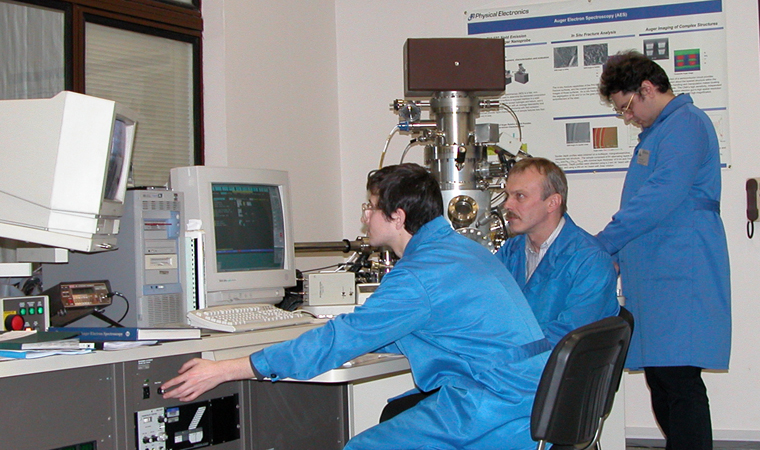
Today OSC works at Giredmet are financed upon the contract with the Russian Ministry of Education. The Institute has also found several industrial partners helping to elaborate technologies. One of them is NT-MDT company which does design and supply of hi tech equipment for nanosized analysis of different objects. “We are interested in materials with expanded spectral range of transmission, which are being designed in Giredmet, – says Pavel Dorozhkin, Head of Applications & Product Development Department of NT-MDT. – That’s why we are the Institute’s industrial partner; using our devices and our experience we can analyze very complex structures, their nanosized chemical composition, study optical behavior, estimate photoelectric efficiency, their homogeneity and quality. Our equipment is ideal for analyzing testing structures and optimization of technological processes of OCS production”.
Giredmet is planning to get the first patents as early as next year. “When we get ready samples of the items, we’ll get in contact with Rosatom’s investing committee”, – says Marat Bulatov. – We are hoping to get funding of the first batch”.