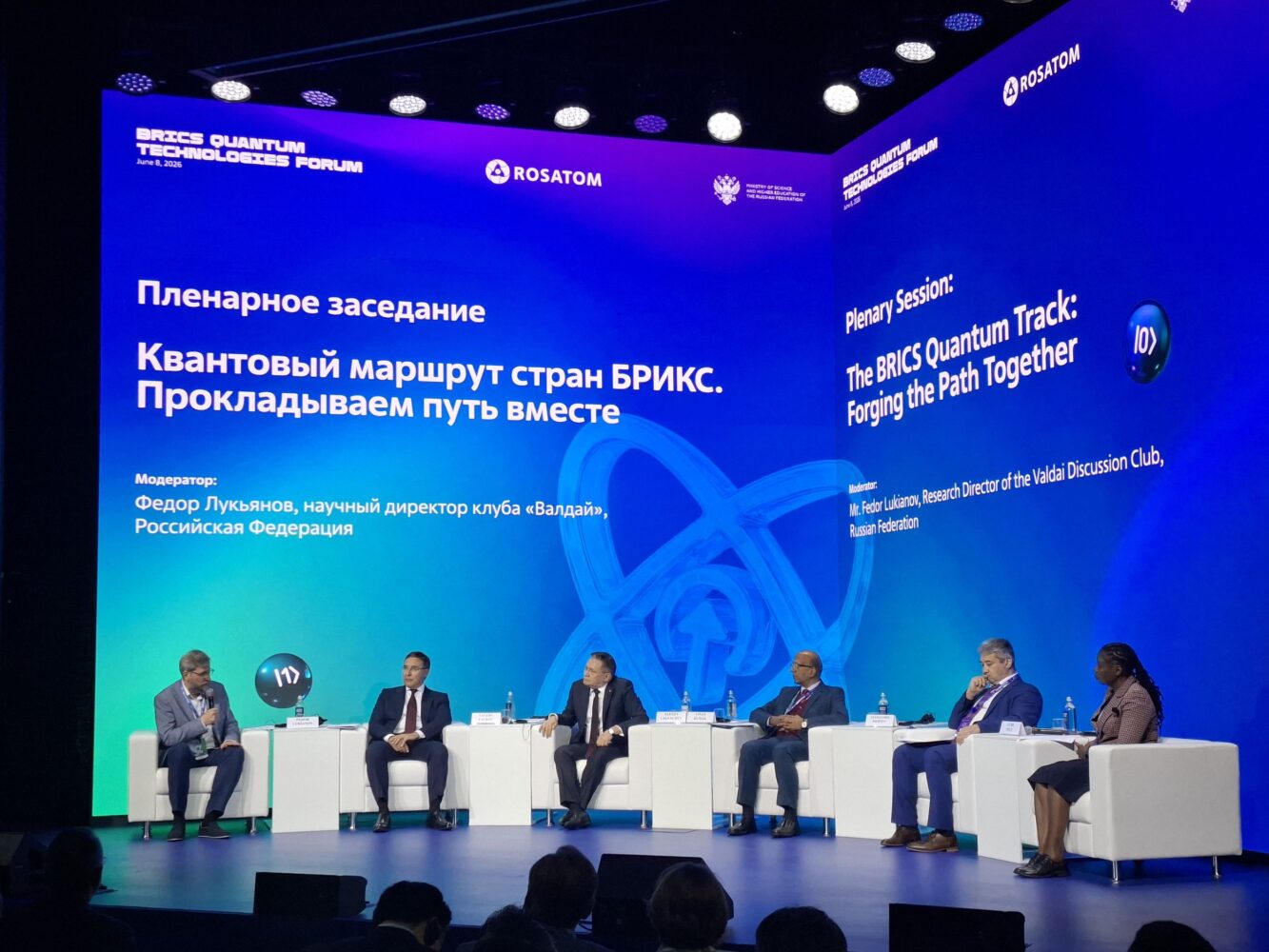
In June, Moscow hosted the 1st BRICS Quantum Forum. Speaking at the event, Rosatom Director General Alexey Likhachev announced the start of discussions on a 10-year quantum technology development strategy. Researchers, government officials, and business representatives from various countries proposed pathways for international cooperation.
Alexey Likhachev started the event with a welcoming address from Russian Prime Minister Mikhail Mishustin: “The Russian Federation is open to international cooperation in quantum research. In recent years, our country has achieved a stream of world-class results. And we are ready to share our experience and best practices in this field.”
Alexey Likhachev reaffirmed that Russia is open to cooperation in quantum technologies: “Seven quantum computers and dozens of algorithms in quantum computing, quantum sensing, and quantum communications — this is the wealth of assets we enthusiastically and unconditionally bring to the table for joint cooperation. I am confident that other countries will do the same, because we are stronger together,” the Rosatom chief continued.
Forms of cooperation
The plenary session titled “BRICS Quantum Route: Paving the Way Together” and involving physicists, representatives of international NGOs, government officials, and business leaders from various countries explored national achievements in quantum engineering and proposed ways to structure cooperation.
Russian Minister of Science and Higher Education Valery Falkov noted that Russian research teams have made significant strides in creating prototype quantum processors, scaling up from two qubits at the start of their work in 2020 to 70 qubits by the end of 2025. These computers are already solving test problems and will be highly sought after in the real economy.
Russia is active in developing its research infrastructure. For instance, a national research computer network has been established; it hosts an inter-university quantum key distribution network for testing new information security technologies.
Forty-seven Russian universities and academic centers offer training programs in quantum technologies to undergraduate and graduate students of various disciplines. Quantum R&D centers have been established at the National Research Nuclear University MEPhI and the Moscow Institute of Physics and Technology.
According to Valery Falkov, the points of mutual interest for BRICS countries include academic exchange programs, joint research, and the development of common standards or their mutual recognition. Another focal point is the shared use of research infrastructure. “When addressing fundamental challenges under conditions of high uncertainty, we will reach our goals much faster if we move together,” the minister concluded.
Vinay Kumar, Ambassador Extraordinary and Plenipotentiary of India to the Russian Federation, supported the enhancement of academic mobility and the involvement of students in exchange programs. He also pointed out that quantum technologies require billions in investment. In his opinion, China could become an industrial partner in quantum cooperation, which would give the collaboration a new impetus.
Alexander Shoytov, Russian Deputy Minister of Digital Development, Communications and Mass Media, said that academic collaborations are expected to yield quantum computers with a large number of qubits, the development of quantum memory, increased data transfer speeds, and extended distances in quantum communications. The emergence of hybrid computers powered by artificial intelligence is also anticipated. “We are doing all of this in Russia, but a breakthrough requires the consolidation of a broader community,” Alexander Shoytov noted. He believes that efforts should be united in fundamental and applied research, with a focus on developing algorithms and software. Another area of mutual interest is linking the quantum communication networks of partner countries, incorporating data re-encryption at the borders.
Nikolay Kolachevsky, Scientific Director of the Quantum Computing Roadmap and a member of the Russian Academy of Sciences, spoke about the capabilities of other BRICS member states in the quantum field: “India has a very strong mathematical school, encompassing algorithm developers and programmers. Joint quantum projects in space hold great promise with China. We can also talk about the mutual exchange of hardware components for quantum computing.” The starting point, however, must be mutual visits by scientists and students, joint projects, and grants, Nikolay Kolachevsky emphasized.
Looking to the future
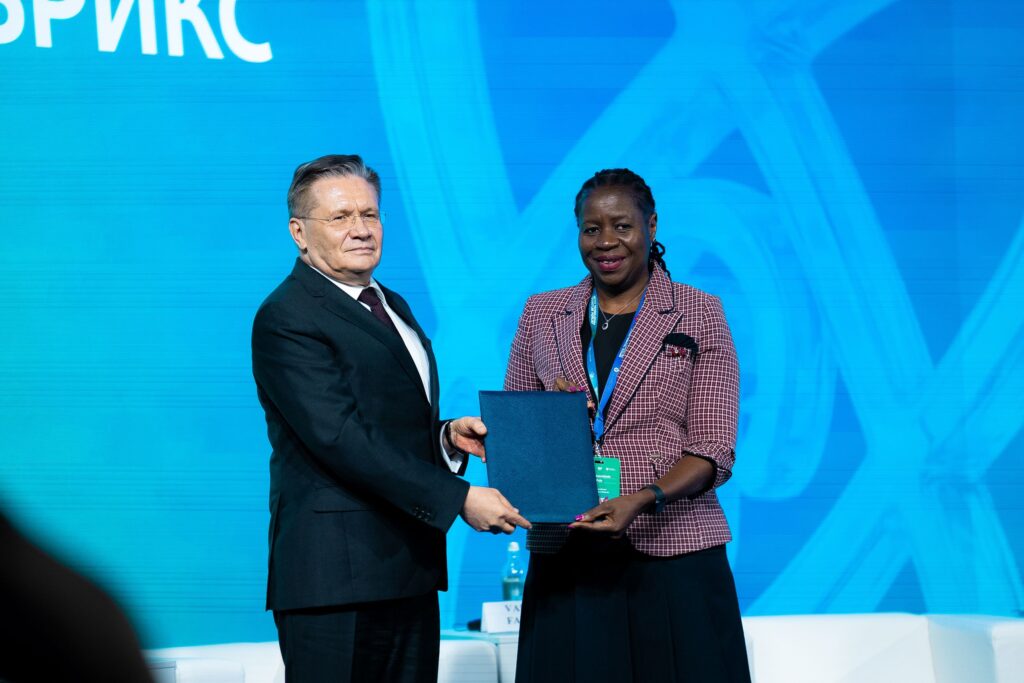
Elsie Pule, Chief Coordinator of the BRICS Nuclear Energy Platform, signed a joint statement made by its participants. “We recognize the strong potential of quantum computing in peaceful uses of nuclear energy to solve a wide range of modeling and engineering tasks, optimize production and logistics processes, and develop new materials and technologies,” the document says. “We must universally integrate quantum technologies into the nuclear energy sector,” Elsie Pule commented. Following the forum, the delegations adopted a statement reaffirming their intention to maintain contacts in the field of quantum technologies.
“Over the past 30 years, BRICS has evolved into a highly influential international entity with a far-reaching, profound agenda. Introducing quantum topics into it is a great historical mission. And I am confident that we will succeed together,” Alexey Likhachev concluded.
Photo by: Rosatom Quantum Technologies