In August, the seventh international Arctic expedition, the Icebreaker of Knowledge, came to a close. It brought together high school and vocational school students from Russia and 22 countries around the world.
The Icebreaker of Knowledge science outreach initiative has been held since 2012. Over six seasons, more than 400 young people have visited the North Pole, with competition reaching around 1,400 applicants per spot.
To join the expedition, participants had to pass a rigorous selection process that included online tests, a video assignment, in-person semifinals, and an in-person final in Moscow. This year, over 73,000 Russian high school and vocational school students aged 14 to 16 from all regions of the country took part in the Icebreaker of Knowledge initiative. They competed in three tracks. The Explorer track is intended for future researchers, scientists, and science communicators. The Creator brings together future engineers and designers. The Master track, which was included in the program for the first time this year, is for future highly skilled professionals. Following three stages of the open competition, 27 individuals from all eight federal districts of Russia were selected as winners.
The expedition also included the winners of the international selection — one representative from each of 22 countries across Europe, Asia, Latin America, and Africa — as well as winners of international and national olympiads and competitions.
Science amidst the ice
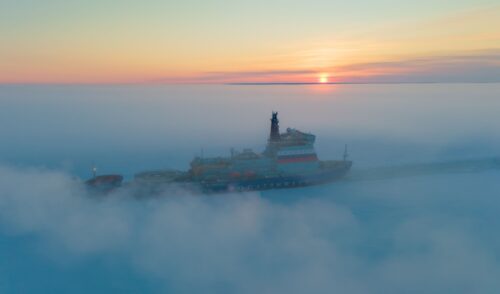
The seventh expedition departed from Murmansk on August 4. As in previous years, the vessel that took expedition members to the North Pole was the 50 Let Pobedy (50 Years of Victory) nuclear icebreaker, captained by Ruslan Sasov.
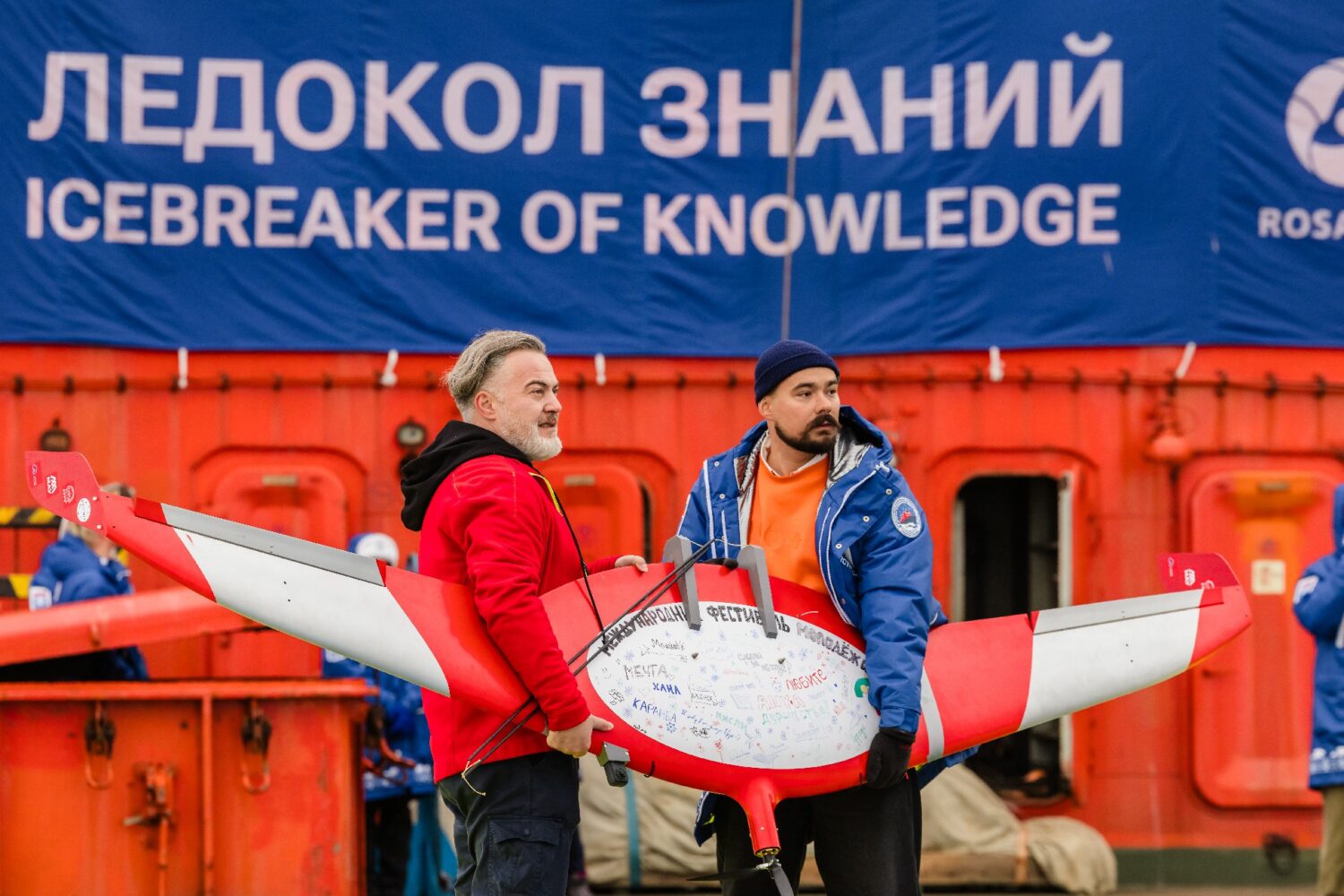
The highlight of the program was the launch of a high-altitude platform station into the stratosphere. Designed for environmental monitoring of the Arctic, it was developed through joint efforts of the Murmansk Arctic University, the Stratonautics Laboratory, Harbin Institute of Technology, and the Environmental Defenders Foundation. The platform station is equipped with a suite of sensors and an experimental multispectral camera. The platform was launched for the first time in the area of the Franz Josef Land archipelago, rose to an altitude of more than 15 km, traveled over 100 km, and successfully landed at a designated point on Hooker Island. After landing, the device was delivered back on board the nuclear icebreaker 50 Let Pobedy by the crew and inspectors of the Russian Arctic National Park. One of the experiments focused on testing stable communications at high latitudes. The collected data will help scientists monitor conditions along the Northern Sea Route, assess the impacts of climate change, and observe marine animal populations.
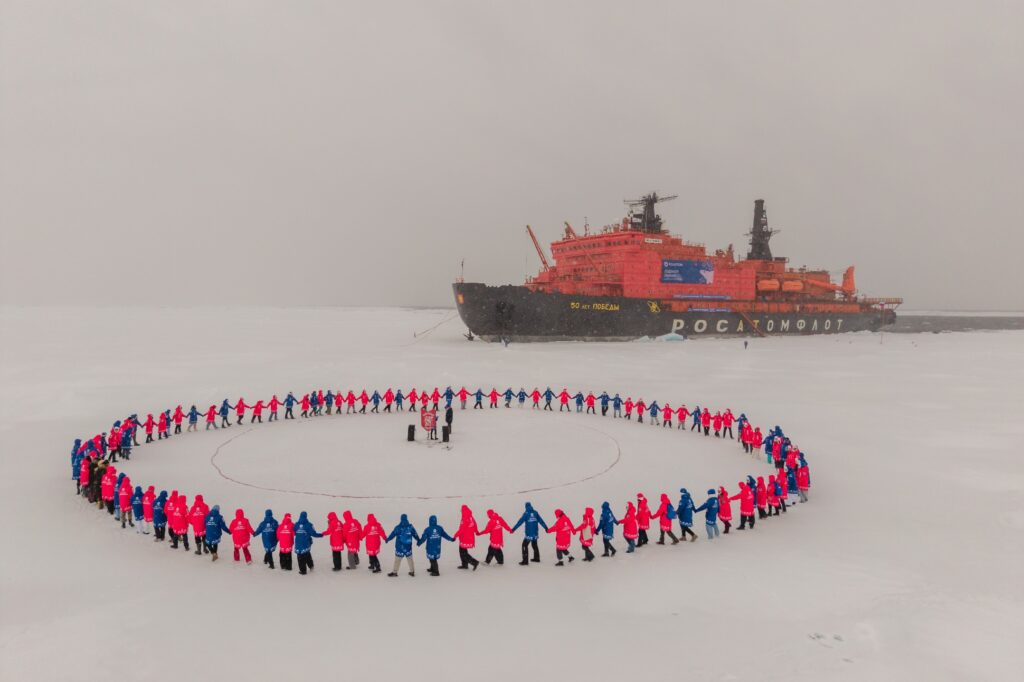
In addition, a flash mob dedicated to the Year of Unity of the Peoples of Russia was held at the North Pole. The flash mob participants walked in an international circle dance around the top of the Earth. It was held to a live performance by the music band AY YOLA from Bashkortostan.
Also, following tradition, the expedition members took the “shortest journey around the world.” This tradition was started by the sailors who first reached the North Pole aboard the Arktika nuclear icebreaker in 1977. During the stop at the Pole, the expedition members also watched the northernmost stand-up comedy show prepared by Vika Zhang, a social media influencer with over a million followers.
Along the route, the expedition members enjoyed a packed educational program. Every day, experts — scientists, engineers, and senior executives from Rosatom — delivered lectures and held master classes. “At Rosatom, every day we work on things that only yesterday seemed like science fiction — from quantum technologies to biofabrication. That is why it is especially important for us to show these things to young people in person, and it is wonderful that this can be done right on board the nuclear icebreaker “50 Let Pobedy”. During the expedition, the children saw that Russian science is about the future and about real technologies that change people’s lives for the better,” – noted Egor Plakhotnyuk, expert of the Icebreaker of Knowledge scientific and educational expedition, and project head at the Laboratory of Genomic Technologies and Tissue Engineering of the Research Institute of Technical Physics and Automation. The students also received career counseling on professional development in the nuclear industry.
And, of course, the most mesmerizing part of the voyage was observing the Arctic’s unique natural environment day after day. The expedition members marveled at giant icebergs. On Franz Josef Land, home to a nature reserve, they watched a massive seabird colony — a towering cliff teeming with Arctic birds. Along the route, they also encountered a polar bear, the animal that is often called the “King of the Arctic.”
“We have successfully completed the seventh voyage of the Arctic expedition “Icebreaker of Knowledge”. The crew always treats this project with special care: such voyages truly contribute to the development of the younger generation. The smartest and most talented young people take part in this expedition — and once again, we were convinced of that. Many of them dreamed of visiting the North Pole and seeing polar bears, and I am very glad that Rosatom and our crew helped make that dream come true,” — said Ruslan Sasov, Captain of the nuclear icebreaker 50 Let Pobedy.
This site uses cookies. By continuing your navigation, you accept the use of cookies. For more information, or to manage or to change the cookies parameters on your computer, read our Cookies Policy. Learn more